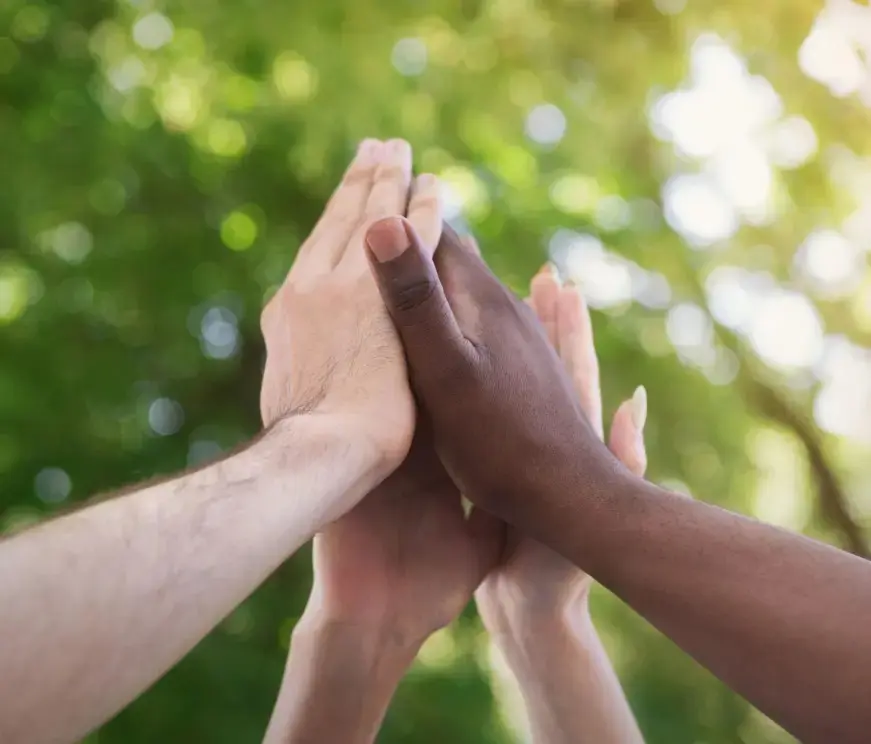
Community leaders in NAM’s Building Trust in Health Science through Community Partnership and Lived Experience Action Collaborative share why they believe in the program and what they hope it can accomplish for the field.
Interview edited by Courtney Flaherty
For years, the people working to bridge the gap in trust between scientific institutions and the public have heard the same call: listen to the community. But listening is only the first step. Too often, community engagement becomes a box to check, with people invited to share their experiences and concerns without having a meaningful role in shaping responses. The resulting solutions may fail to address their real-world needs or the systemic issues underlying them. There is a call to action to move beyond community engagement to true partnership with community.
The Strategic Anchors of the National Academy of Medicine (NAM)’s Building Trust in Health Science through Community Partnership and Lived Experience Action Collaborative have seen those limitations firsthand. Now, these leaders are bringing their experience to a program they believe has the potential to do something different.
Strategic Anchors are the foundation of the Collaborative’s leadership structure. Anchors are Action Collaborative members who are nominated by their colleagues to lead each of the Collaborative’s leadership workgroups, known as pods. These pods are focused on developing community-informed pathways to build trust in the following areas: Health Science Research, Community Partnership, and Communications and Education.
“The most radical thing we are trying to do is to build genuine, respectful, and sustainable relationships with each another” said Ricardo Garay, a Strategic Anchor for the Collaborative and community organizer in Austin with more than two decades of experience working alongside immigrant, refugee, low-income, and other communities affected by structural violence. “We must respect the “people’s history” and show solidarity with those that need the most. I hope that this initiative ultimately inspires us to make sure that we’re listening to each other but also translating that understanding into action across all our spheres of influence.”
To explore what this approach looks like in practice, NAM spoke with Garay and fellow participants in the Collaborative’s first cohort of Strategic Anchors:
- David O. Fakunle II: a public health professor, artist, and longtime practitioner of Black storytelling, African drumming, singing, and theater who has spent more than 25 years using arts and culture to advance health, equity, and liberation.
- Beth Michel: a citizen of the Tohono O’odham Nation as well as Hopi and Navajo and Tribal Nation community-engagement leader who has spent 8 years working with more than 30 Tribal health programs and Native-serving organizations.
- Rhonda K. Beaver: a citizen of the Muscogee (Creek) Nation and Cherokee descendant with more than 24 years of experience in Tribal health administration and operations, advocating for Indigenous voices, sovereignty, and culturally informed care.
- Hannah Drake: a Kentucky-based poet, activist, public speaker, and author of 11 books who uses storytelling and art to challenge audiences and bring overlooked histories and issues into public conversation.
- Moira McGuire: a retired US Public Health Service nurse officer with more than three decades of experience across federal health care and public health, including creating the Arts in Health Program at Walter Reed National Military Medical Center.
- Juan Rios: an Afro-Latino scholar-practitioner and health policy leader working at the intersection of mental health, community justice, and technology, with a focus on culturally responsive and community-centered systems of care.
- Nathaniel L. Siggers: a peer support specialist and addiction and recovery trainer who works directly with patients and communities to develop treatment and training approaches around individual needs and backgrounds.
- Elisabeth Marnik: a scientist-turned-public science communicator who grew up in a home that distrusted science and medicine and now works to make science and public health clear, compassionate, and useful in everyday life.
In the following conversation, these members reflect on what they have learned from working across disciplines and lived experiences, why genuine partnership requires more than simply inviting different voices to the table, and how institutions can create a model in which communities have agency in what happens next.
This interview has been edited for length and clarity.
Why did you decide to join this Collaborative?
Fakunle: I saw it as an opportunity to do something very impactful and quite powerful in this moment. The idea of trust in health spaces, not just medical spaces, but public health spaces, is honestly the elephant in the room for most of the things that we do. And it’s the elephant in the room because the lack of trust is directly tied to histories of oppression, suppression, dehumanization, minimalization, and I can go on and on and on.
The reasons that many people around the country are not open within their health spaces and with health professionals are warranted. This has felt like an actual effort to address those fundamental issues within this capacity. I know it’s way bigger than what this initiative can do, but it’s a step in the right direction.
Michel: I was most excited about joining the collaborative because we are striving to build trust in health science. This indicates to me that we’re building something that hasn’t been established yet. I appreciate that we are at the very beginning and our collaborative includes people who remain connected to their community while we are also thinking through what we can do differently to ensure trust in health sciences.
When I hear about national conversations, I rarely see community members from the Tohono O’odham Nation. This was a chance to have an O’odham voice and an O’odham perspective at the national level.
Beaver: When we talk about Tribal health, we’re talking about more than a community perspective. We’re talking about Tribal sovereignty and the government-to-government relationship between Tribes and the federal government. Tribes have been taking care of their people for since time immemorial, and we will continue to do that.
For many Tribal people, mistrust of the federal government is rooted in broken treaty obligations and broken promises. I joined to bring a Tribal perspective on how we have survived and continued to care for our people, while also learning from others at the table.
My mom used to always say, “You got to leave it better than you found it, Rhonda Kay.” That’s what I hope to do here, even if it’s in a small way. I also want to learn from others at the table and take that knowledge back to the Tribes I work alongside.”
Garay: As a local community organizer, I’m typically skeptical of spending time on a national initiative because it could take me away from the immediate needs in my community. At the same time, I believe this could be a unique opportunity to export what I’m seeing on the ground and have that be something that helps others around the country and the world. As a community health worker, we educate, advocate and direct folks at an institution but also stay in the community and help navigate and inform. That bi-directional nature of what we do is something that I’m very interested in expanding.
An initiative like this is also a huge opportunity to question power and traditional structures. What if instead of having a big institution direct us (the community), we could actually do the opposite and direct it where to go, what to do, and how to do it? That degree of institutional humility is something that could truly be revolutionary at a national level.
Siggers: Who wouldn’t want to be part of an organization of people doing what they do best? Just having an opportunity to work with people from all across the country doing great work is exciting. It also helps me learn from everyone. If we can do work on a national level, then we can scale that down and make a difference in our local communities.
Drake: As a Black person, and similarly, a Black woman, I can speak about the medical mistrust that many of us face in the community, and it’s happened to me personally. I wanted to participate just because of something that impacts me and my loved ones, has impacted my family.
Especially as an artist, I’m always thinking about how I can use my artwork to have conversations around medical topics. Poetically, I’ve written many columns on medical issues and how they affect the community. Personally, just thinking about my own medical issues and how I have felt in the dentist’s office and in the doctor’s office—I don’t think anyone should feel like that when it comes to their health. So, if there’s anything that I can do to change this, then I want to do it.
Marnik: So much of what we do in our careers and in our lives occur with in silos. One of the benefits of the work that we are doing is it has brought together so many people from different backgrounds who have the same desire to change the system. That’s not what I typically encounter in institutions. It’s nice to be among people who care and who are also really thinking about the creative ways in which we can build a better system. Many people tend to narrowly view the problem with our public health institutions as if they are new, when in reality these issues have existed long before what we’re facing right now.
What have you learned from working together through the Collaborative and its pods?
Michel: I sit in the community partnership pod. That is an important piece of this work because while we have good representation of practitioners, nurses and public health providers, the community partnership are the stones in the creek serving as steps to cross the water while experiencing the waters flow and learning from it. We are focused on the supporting both groups to understand that trust is a central part of how health can be successful.
It’s important to be in this space and listen because it takes our own community conversations further toward a solution-oriented mindset.
McGuire: I think the work, at its core, is correcting systems that have been built in unjust ways. With this Collaborative, we’re working together with people who honestly, in a way, renew my faith in humanity.
I’ve always had a soft spot for people whose work and contributions are so profound and yet they’re kind of unseen. The Collective has so many of these people who are working in their communities, doing really challenging work and they definitely have my admiration. The members of the Collective are so determined and so passionate and so grounded and so focused that they know why they’re here and what they’re supposed to do. And they’re doing it.
Rios: Initially, I had some ambivalence about working with other scientists just because of my own previous experiences in spaces with scientists. I usually have more of an ambivalence being in academic pods rather than pods that are more community facing. But that initial ambivalence around those issues subsided because of the relationship aspect of this program.
What I loved most, especially in the in-person gathering, was that it’s really an ecosystem of liberation. The components of our backgrounds, everything we come with, is just an equal contributor to the liberated work, whether it’s being able to tell stories or engage in deep listening while stories are being told.
What does genuine community partnership require, and how does it change the traditional relationship between institutions and communities?
Michel: I think the shift that’s happening is increased awareness from communities across the country who understand an information exchange between institutions and communities now includes a community’s agency and ownership of their data, whether it’s quantitative or qualitative. It’s their data to help institutions do work further downstream. The communities should be the ones helping us understand what the data are saying about their community, rather than institutions collecting and attempting to analyze it on our own. It should be a collaborative effort that allows the community to explain what those stories and the numbers mean, to help shape what should be happening next.
Beaver: It’s important that we tell our own stories. People have been telling stories about us, collecting data on us, and conducting research on us for years. Our data and our stories belong to us. Partnership means respecting each Tribe’s authority to decide how its data are used and how its stories are told. It should be about us, for us, with us, alongside us. We don’t need anybody to come in and save the day for us. We know what we need best.
Drake: I think a lot of people get into medicine because they really want to help people. But I think the institution and the corporation of medicine makes things go sideways, even if one’s heart is in the right place. Sometimes the whole institution of it can cause you to behave a certain way. The community knows what they need. To me, the community’s not the issue. It’s the medical thing that’s the issue. For me, that looks like starting with empathy at the foundation of medical education. This is where we need to get to as a society and the medical community. When you have empathy for people, you don’t neglect and overlook their pain.
Fakunle: Storytelling is the answer. It’s from that space of mutual openness, which is not impossible, that we get a wider spectrum of truth. That’s exactly what people need in this moment, and they can handle it.
Oftentimes in public health, thinking about the students I work with, they’re interested in disparities. They’re interested in inequities and inequalities. And I tell them that you can’t explain the “why” of those inequities and inequalities without the history.
The stories give you the answers in many ways, and they also give you paths by which you can create and imagine the space, the time, the atmosphere that you truly want. Health and medicine are no different.
What needs to happen to ensure these community insights translate into tangible steps forward?
Marnik: For me, when I’m thinking about partnerships, they involve both listening and humility. A lot of the work that I do is interacting online with people, and I see scientists, clinicians, or science communicators responding to people in ways that are not going to help. There needs to be a reckoning in the way in which we train these leaders to really recognize that your lived experience isn’t everyone else’s experience.
One clear intervention has to be changing the systems of how we train our scientists, clinicians, and public health leaders from the earliest we can in the training pipeline. We also need to change the incentives, because science communication and interacting with the public is not typically something that’s focused on in tenure.
You can no longer just publish research papers. That is no longer a sufficient way of being a scientist. You need to also in some way be disseminating the work that you’re doing and why it matters to the public. It doesn’t have to be on social media, but we no longer can just rely on dissemination being only for other scientists.
Garay: Listening without action risks being performative and doing so with folks most impacted by systemic violence can cause tremendous harm. I also think that folks that participate in exercises that are performative can be affected by moral injury as well. This can all lead to cynicism and burnout.
Something that David keeps reminding me of is the importance of storytelling, to be open to understanding one another and empathize. There cannot be empathy without a connection, without accountability, without agency. Without these, there can be no solidarity. I think solidarity and liberation should be the ultimate goal.
For this Collaborative to be successful in your eyes, what needs to be accomplished?
Fakunle: If we’ve done our job with this initiative, then there should, at bare minimum, be a catalyst for culture shifts in health and health care.
Until then, it’s about how do we take the stories of the people that are being shared, and how do we apply our bases of knowledge? How do we apply our power that we already had, and the power given through NAM to reimagine the systems, reimagine the culture?
It’s always people at the center of this, which means we always have access to change the outcomes that people create. That’s all we want: to take what we’ve learned back to our communities, to go back to our neighborhoods, so we’re staying accountable.
Michel: If we’re trying to think through institutional change that will benefit our communities, it’s also about the institutions being willing to invest time in the communities they serve.
When we have CEOs and presidents of health institutions that have never set foot on a reservation or a neighborhood or a community, they have no idea what it’s like to serve the community in the best way possible. Time is a part of remedying that knowledge deficit. Leadership must visit these spaces and see for themselves what is working and what isn’t.
For healthcare professionals that are being trained in their field, it’s having the time to work with the community as well. When they do this, they come away with a new set of skills that help them in their professions. I’m hoping we’re successful because people are willing to build in more time for their training and professional growth.
Drake: As an artist, I want to continue to call attention to these issues. Sometimes people think, “What does this medical malpractice and the government have to do with me?” It has everything to do with you. It has everything to do with you, because a person’s health is not separate from anything that they are dealing with. It’s not separate from the economy, it’s all interconnected. We’ve been building this type of medical system since its inception. We’ve been harming people even starting certain medical practices. Harm is at its foundation.
So how do I, as an artist, start digging these pieces out? I’m just telling a story where it clicks for people that, “Oh, medical malpractice isn’t new. What we see happening today with Black maternal health is systemic. It didn’t just start happening today, it’s a historical thing.”
So that’s it. I’m going to use my art to elevate these stories however I can.
Beaver: When we talk about the mistrust that the nation has or the people have, what I’ve been reminded of during our time together is that the people invited to this table also bring experiences that have shaped their trust in institutions. Building trust has to happen within this Collaborative, too, with NAM and with each other. Building trust with NAM and with each other has also taken time. Part of that process is acknowledging what has happened to our own people and learning about what other communities have experienced. There needs to be room for healing, along with a commitment from institutions to address the harms that contributed to mistrust. I think it’s about meeting people where they are. There have always been different people. There’s always been different perspectives. It’s not a new concept, but it’s finally meeting people where they are and putting their needs first and foremost, instead of trying to get everybody to fit in the same box. That’s not working.
Rios: Trust is on a continuum. It doesn’t just happen overnight or at one event. There’s so much more that we can learn from each other interdisciplinarily and transdisciplinarily about what is possible in this space. Some of us came in thinking, “Well, that can’t be done. It’s not what this pod should be about.” Well, why can’t it be done?
What I hope is that we continue to deconstruct the systems that have contributed to our otherness and reimagine what’s possible and not possible. The goal is to be able to center our systems around global health, our own personal health, and the health of our communities, to help all people live in the best way possible.
Learn more about the Building Trust in Health Science Action Collaborative.
Courtney Flaherty is a science storytelling and social media specialist at the National Academy of Medicine.