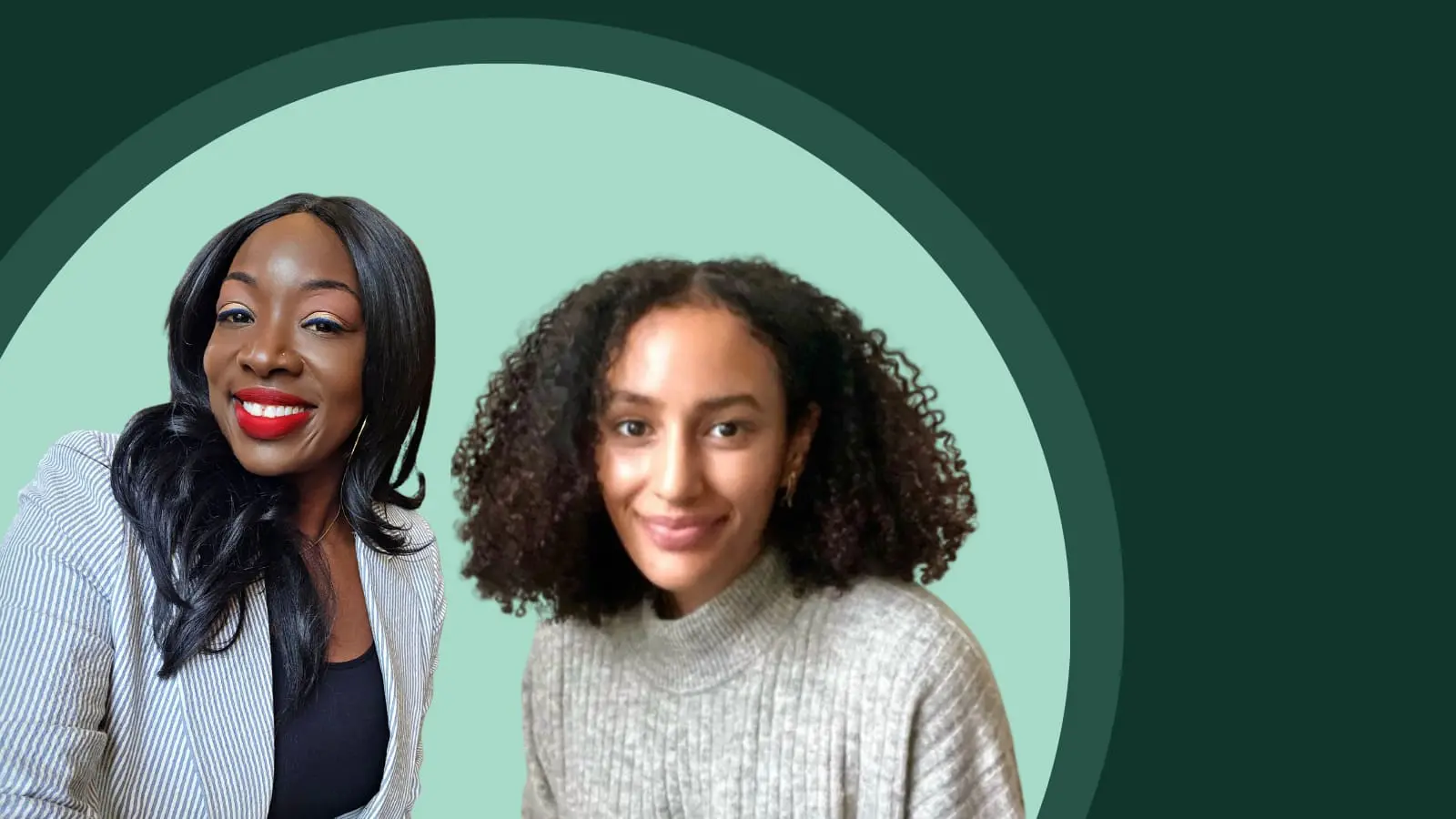
Amy Gyau-Moyer (left) and Elisabeth Solomon (right)
Amy Gyau-Moyer and Elisabeth Solomon discuss how NAM’s Building Trust in Health Science through Community Partnership and Lived Experience Action Collaborative is co-developing community-driven approaches to make health science more trustworthy.
Interview conducted by Karen Bacellar
Trust in health science is not built through information alone. It depends on whether people believe the institutions asking for their trust have listened, followed through, and made room for communities to shape the work from the start.
That idea is at the center of the National Academy of Medicine (NAM)’s Building Trust in Health Science through Community Partnership and Lived Experience Action Collaborative. The Collaborative brings together more than 30 members with expertise across health science, community partnership, communications, and lived experience to test a different model: one where community is not consulted after the fact but drives the work.
 Through Community Trust Circles, collective impact, and results-based accountability, the Collaborative is exploring what it takes for institutions to move from engagement to shared responsibility. Its early work is also helping NAM examine how trust-building happens in practice, including how organizations listen, measure progress, and hold themselves accountable to the people their work is meant to serve.
To better understand the collaborative’s model and early work, NAM spoke with director and senior program officer Amy Gyau-Moyer and research assistant Elisabeth Solomon. In the following interview, they discuss why community partnership and lived experience are central to health science, what the collaborative has already put in motion, and what other institutions, researchers, funders, and health leaders can learn from this approach.
This interview has been edited for length and clarity.
Why is trust in health science such an important issue right now?
Gyau‑Moyer: Trust across society, not just in health science is at a critical point. We’re living in a time marked by weakened social connection, declining institutional confidence, and competing sources of information. In health and medicine, when trust breaks down, the consequences are profound. Health science is meant to save lives, support prevention, and guide early intervention across communities and lifespans.
If the people or institutions sharing that information are not trusted, the information will not be used. And when lifesaving guidance is ignored, lives are at stake. Trust is not complicated. It’s built through consistent actions, transparency, and honesty even when things are difficult. It is essential to health and well‑being.
Solomon: Amy captured that beautifully. What she is saying is also reflected in the data from external sources and our own literature review. When there is a lack of trust, health outcomes are not optimal. Trust is vital. Health science, at its core, is meant to improve people’s lives. Institutions should be structured in ways that place trust at the center, because it enables that shared vision of health for everyone, everywhere.
What is the Building Trust in Health Science through Community Partnership and Lived Experience Action Collaborative, and why was it started?
Gyau‑Moyer: The Action Collaborative includes more than 30 members and uses a dual‑level strategy: partnering intentionally and authentically with community from the beginning, while also advancing a national effort to strengthen trust in health science.
Historically, communities most affected by health science research have not been meaningfully included. They are often consulted briefly or asked for one‑time input. Today, that approach is no longer acceptable. We cannot succeed without community partnership from the start.
Our model aims to demonstrate that working with communities throughout the research and decision‑making process is itself a relationship‑builder and that by changing how we operate, we also become more trustworthy as institutions, not the barrier.
Solomon: We’ve seen so many great trust-building and community engagement efforts, both in the U.S. and internationally. Each one doing important work. But we noticed a gap: few efforts intentionally connect local and national strategies from an operational and relational perspective. We saw this gap and created a model that works on both levels, with a commitment to critically evaluating our trust building efforts along the way for transparent accountability.
What makes this Action Collaborative’s model different?
Gyau‑Moyer: The National Academy of Medicine’s Action Collaborative model brings together experts across health science disciplines to address major barriers to trust in health science. For this work, we knew we needed a framework that intentionally centers community partnership and lived experience, guides how we work together and holds us accountable.
We drew from evidence‑based approaches such as collective impact which emphasizes shared vision, bi-directional feedback loops, transparency and just data practices that honor community sovereignty then paired it with results‑based accountability, which asks three simple but powerful questions: What are we doing? How well are we doing it? Is anyone better off?
This combination allows us to track, with community partners, whether our efforts are producing the intended outcomes. Many organizations say they’ve been doing work for years but when evaluated honestly, the question remains: Has it truly made people’s lives better? Especially in the ways that they deem important.
We are transparent about our learning process. We know we don’t have all the answers, and we are committed to evolving. From a personal standpoint, I cannot imagine someone designing a solution to a problem I experience without my involvement. Health science is an applied field focused on human well‑being; without lived experience at the table, we will miss the nuances that make health science stronger and more effective.
Solomon: Our research approach which is grounded in community health needs assessments and national and local datasets; this was simply our starting point. What truly guides this work are the people and communities we partner with. We do not prescribe what communities should do. We center co-development, letting communities set the agenda and define the priorities.
Community partnership and lived experience are central because it’s not only rich with the stories and narratives of people, but with solutions. If the work is for community, you can’t do it without community by your side. It’s really the job of institutions to listen, partner, and work alongside community leaders.
Gyau‑Moyer: Leadership in health science has traditionally excluded people outside research and medicine. Community members are often engaged only after decisions are made. That approach overlooks the relational work needed to understand lived realities and often results in what many call helicopter research. We wanted to avoid that entirely.
“From a personal perspective, I cannot imagine someone developing a solution to a problem that I have without my consultation.” — Amy Gyau‑Moyer
We began with a landscape assessment of peer‑reviewed and grey literature to understand national barriers to community partnership. We reviewed community health needs assessments, community health improvement plans and national scorecards to identify areas of mistrust and structural gaps. From that, we created a roles‑and‑goals matrix to determine exactly who needed to be part of the Action Collaborative.
Who is part of the Collaborative and how did you bring members together?
Gyau‑Moyer: The roles-and goals matrix led us to a diverse group: residents and leaders with lived experience who are trusted in their neighborhoods, storytellers, content creators, researchers, social scientists, and people who bridge multiple worlds along with leaders in health sciences. Some had never formally engaged with health science but are trusted messengers in their communities. The result is a dynamic, non-traditional mix of people who bring perspectives rarely included in national conversations.
Solomon: I’ll add that as we began searching for members, we knew there were people already doing this community health work on the ground. So, a lot of our initial process was finding organizations, making calls, and connecting with people.
Our collaborative also builds on long-standing partnerships with local organizations doing incredible work for their communities. Bringing these partners in was essential because authentic partnership means nurturing, respecting, and learning from relationships that already exist. We wanted to reflect and model that in the collaborative.
Gyau‑Moyer: This work required patience. Trust is built at the speed of relationships, not the speed of timelines. As we built the model, we also built relationships while following the data, making the calls, nurturing new partnerships and deepening existing ones. We knew the work would be challenging, but we also knew that if we came together with intention, something meaningful could happen.
Bringing this group together that is grounded in data, relationships, and shared purpose was itself a major accomplishment.
Solomon: We also wanted to be intentional in how our 32 Action Collaborative members work alongside each other.
For example, we have a flat leadership structure. Instead of a typical steering committee, members nominate who they want as leaders. Those leaders work closely with us as Strategic Anchors throughout the initiative. We also created six-month term limits, where members can either re-elect the Strategic Anchors or elect a new group of folks to lead their pods.
The reason we did this was not only for the bandwidth of our members, but also to make sure all voices and perspectives are heard.
What has the Collaborative already accomplished or put in motion?
Solomon: In December 2025, we convened all members for training in collective impact and results‑based accountability. This created a shared foundation for how we work together. With support from the Tamarack Institute, every member received certification, allowing us to operationalize these frameworks consistently.
Our landscape research was another major milestone. By layering national, local, and community‑level data, we identified where trust‑building efforts should begin.
Gyau‑Moyer: Bringing this group together intentionally, relationally and within a tight timeframe was a significant achievement. We have remained non‑negotiable about using an evidence‑based, community‑centered framework because it works and because it honors lived experience.
Many people in our Collaborative have had difficult experiences with health science. To see them step forward and say, “I want to be part of the solution, and my input matters,” is powerful. It reflects the trust we are building with each other and the shared commitment to doing this work differently.
When we created this particular Action Collaborative concept, we knew a national effort could not stand alone. Communities needed to be engaged at the same level with shared responsibility, accountability, leadership and decision‑making power. That led to the development of the Community Trust Circle model, and Elisabeth guided us through securing IRB approval for it—the first time NAM had ever done so. Achieving IRB approval is a major milestone because it allows this model to be embedded across current and future NAM work.
How does the Community Trust Circle model work, and how does it connect to the broader Action Collaborative?
Solomon: Community Trust Circles are conversations held by partner communities at the local level. These conversations explore what drives mistrust in health science institutions and determine whether our existing research reflects the lived experience, narratives, and nuances of those communities.
Insights gathered from the Trust Circles are confirmed and approved by community and then shared with the Action Collaborative members at the national level. Then, community leaders and collaborative members co-develop solutions that keep community expertise at the forefront, modeling the more trustworthy health science ecosystem they are tasked with building.
A core principle the Community Trust Circle model is the belief that expertise lives within communities. While there is valuable knowledge at the national level, its primary role and responsibility is to amplify, support, and scale what communities already know. Completing our pilot Trust Circle in Anacostia with our partners at Martha’s Table, the Anacostia Coordinating Council, and Optimal Health Outcomes East of the River was a major accomplishment.
Gyau‑Moyer: That inaugural partnership to develop the Community Trust Circles was spearheaded by our partnership with the Coalition for Trust in Health and Science created by Dr. Reed Tuckson. Another example of how this work can be complimentary and not duplicative. The data we’re receiving already shows a striking contrast between what national research says about building trust in health science and what communities themselves tell us. This insight is helping us communicate, collaborate and understand how our work is actually experienced because community members were involved from the beginning.
People often say they want to work with community partners. Our model offers concrete steps while still centering relationships, which is rare.
Solomon: And those steps are measurable.
What do you hope institutions, researchers, funders, and health leaders learn from this work?
Gyau‑Moyer: People are doing incredible work in their fields, but they should ask themselves: What comes next? Who can you collaborate with to fill gaps in your work? What challenges become solvable when tackled collectively rather than alone?
Our model isn’t the “easy” way, it’s the realistic way to bring systems together and use individual strengths for collective innovation. Everyone has a stake in health and well‑being, from individuals to local communities to national systems. When we listen to each other and follow through, health science will not be distant or inaccessible as people often experience.
Accountability is also essential. Sometimes you must return to the drawing board. Sometimes you must “lead from behind” and let communities guide the work because they know what is best for them. That requires humility and to be honest our field doesn’t always embrace that. Reflecting honestly on how to improve even when it means not being centered is difficult sometimes but necessary.
Solomon: Exactly. Institutions and leaders should evaluate their community engagement or partnership efforts by asking results‑based accountability questions: How much did we do? How well did we do it? And most importantly, is anyone better off? Critically examining past partnerships and identifying who truly benefited can guide meaningful change. Models like collective impact and results‑based accountability can help.
Gyau‑Moyer: We also need to rethink what we consider “expertise.” When we recognize communities and people outside traditional health science as reliable sources of knowledge, our understanding of disease, root causes and the health ecosystem shifts. Sometimes what institutions assume is helpful can actually cause harm and that erodes trust.
If we consistently ask, “Is anyone better off because of this work?” and build structures that support collaboration and accountability, trust becomes a natural outcome. The question is no longer “Why aren’t we being trusted?” but “How do we continue to be trustworthy by understanding where we can improve?”
Learn more about the Building Trust in Health Science Action Collaborative.
Karen Bacellar is a writer, editor, and Deputy Communications Director at the National Academy of Medicine.