Interview by Laura DeStefano
The May 2026 Ebola outbreak in the Democratic Republic of Congo (DRC) and Uganda has renewed concern about emerging infectious diseases and the world’s ability to respond. Although Ebola outbreaks are typically concentrated in parts of Central and West Africa, the interconnected nature of modern travel means even geographically limited outbreaks deserve close international attention.
The current outbreak has raised additional questions because it involves a rare strain of Ebola, Bundibugyo, which has a high fatality rate and for which no specific vaccines or treatments exist. It is also quickly proving to be a large outbreak. According to the World Health Organization (WHO), as of May 20, 2026, approximately 600 suspected cases had been reported, including 139 deaths among suspected cases. 51 confirmed cases had been reported in the DRC, alongside two imported cases in Uganda. Public health authorities, particularly the WHO, are taking measures to contain the outbreak while researchers work to better understand the virus and evaluate potential medical countermeasures.
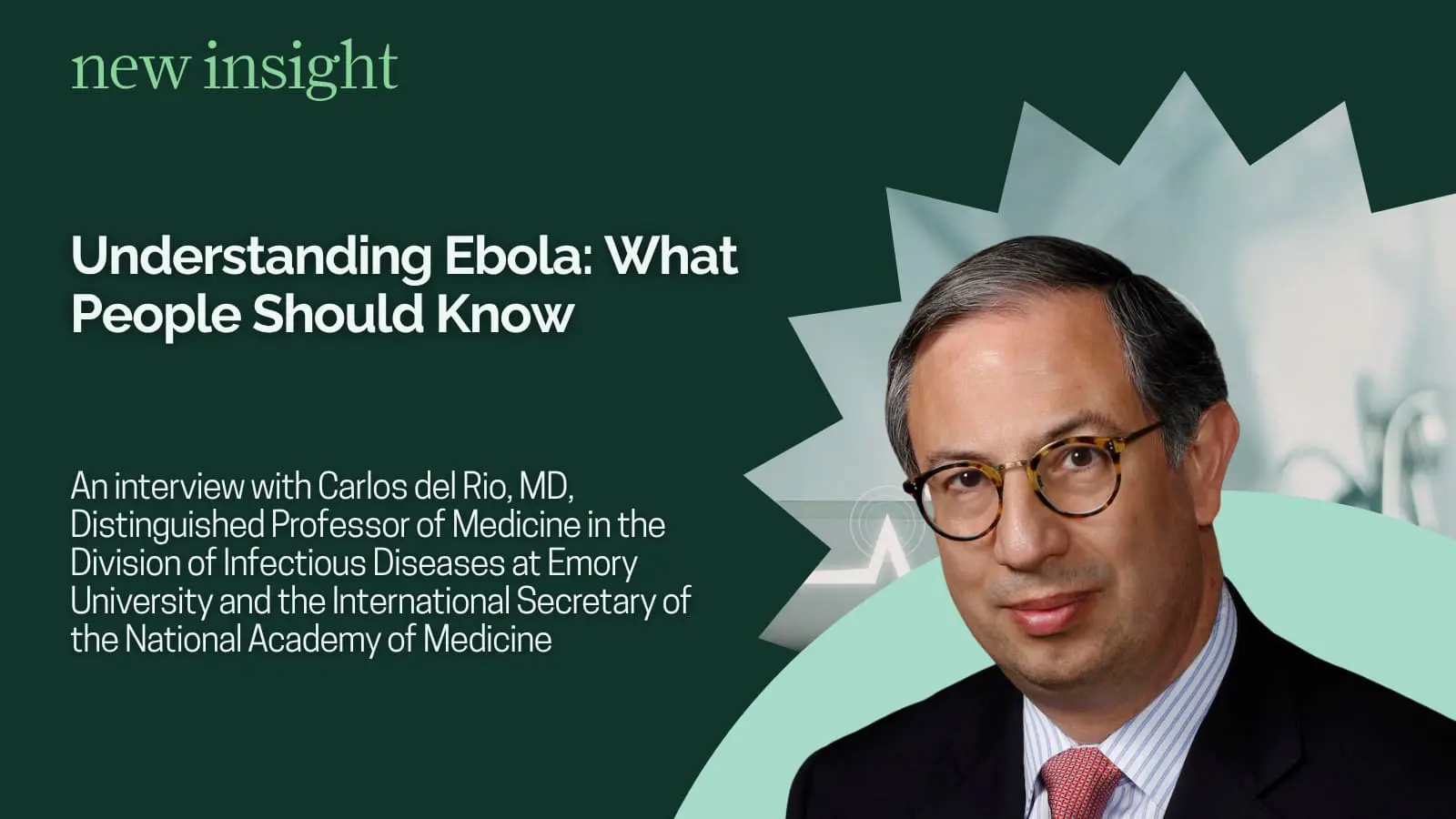
To help explain what Ebola is, how it spreads, and what the latest outbreak means for the broader public, the NAM spoke with Carlos del Rio, MD, Distinguished Professor of Medicine in the Division of Infectious Diseases at Emory University and the International Secretary of the National Academy of Medicine. Del Rio is the co-creator of a free online course on Ebola virus disease. In this interview, he discusses the biology of Ebola, why hemorrhagic viruses are so dangerous, the challenges of vaccine development, and why continued global investment in outbreak preparedness remains essential.
This interview has been edited for length and clarity.
To start with the basics, what is Ebola and how does it spread?
Ebola is a severe viral hemorrhagic fever caused by a group of viruses that are believed to circulate primarily in fruit bats. Humans get infected through contact with infected animals or their bodily fluids. For example, a person can get infected if a bat pees on a mango and they pick the mango, but it’s more likely that chimpanzees and gorillas eat the mango, get infected, and subsequently infect humans who are hunting them.
Ebola then spreads in a population via human-to-human transmission through direct contact with infected blood, vomit, saliva, or other bodily secretions. Caregivers and health care workers are especially vulnerable when they take care of infected persons without proper protective equipment.
What are the symptoms?
Ebola initially causes fever, fatigue, muscle aches, vomiting, and diarrhea. But the reason the disease is so dangerous is it damages blood vessels and prevents blood from clotting properly, leading to widespread internal and external bleeding. Patients can develop a condition called disseminated intravascular coagulation, in which the body simultaneously forms clots and bleeds uncontrollably. Organs begin to fail and patients can essentially bleed to death.
Depending on the availability of medical care, which can be limited in remote areas, Ebola’s fatality rate can be extremely high.
Is there a vaccine?
Yes, two vaccines have been developed and are pre-qualified by the WHO to be used in outbreak situations. However, these vaccines are for the Zaire strain of Ebola and won’t protect against the Bundibugyo strain. It’s not necessarily going to be easy to create a vaccine for Bundibugyo just because we have a vaccine for Zaire. We need research to understand how this strain behaves to produce an effective vaccine.
Are there treatments?
Ebola patients get supportive care to help their bodies recover, including IV fluids, electrolyte management, and intensive care when necessary. They also get monoclonal antibodies – immune therapies that are also used to treat cancer and other diseases. There are currently two monoclonal antibodies (Inmazeb and Ebanga) approved by the U.S. Food & Drug Administration to treat Ebola virus disease caused by Zaire. These antibodies function by binding to the virus’s surface glycoprotein, blocking it from entering and infecting human cells.
Why are Ebola outbreaks usually concentrated in parts of Africa? Could they occur elsewhere?
They happen in Africa because that’s where the fruit bats that host the virus live. Ebola isn’t likely to move out of the region unless it’s carried by humans. Occasionally, infected travelers have carried Ebola to other countries — including the United States during the 2014 outbreak — but it didn’t lead to an outbreak outside Africa.
Travel is always a concern because it’s so easy and fast to carry a disease across borders. But Ebola is much harder to spread than airborne viruses (like COVID-19) because transmission requires close contact with bodily fluids. Public health measures like isolation and contact tracing are very effective at stopping Ebola outbreaks when they are implemented quickly.
How has the global response to Ebola changed since 2014?
We’ve learned a lot. We have vaccines and better diagnostics and therapeutics — but only against the Zaire virus strain, which is also the most common. We have also strengthened outbreak response systems. The WHO has played a really important role in coordinating surveillance, public communication, and emergency response. But the loss of the United States Agency for International Development (USAID), which used to provide health care in Africa, and the U.S. withdrawal from the WHO have been a real setback in responding to infectious disease outbreaks, particularly in remote areas.
Why should Americans care about outbreaks happening thousands of miles away?
Infectious diseases anywhere in the world can potentially become a global concern and arrive in the United States. COVID-19 demonstrated how interconnected the world has become. Even when the immediate risk to Americans is low, monitoring and responding to outbreaks early is critical to preventing larger crises later.
Read More About Ebola:
Read the latest insights from the NAM community.
Laura DeStefano is the Director of Strategic Communications & Engagement at the National Academy of Medicine and a science communicator.