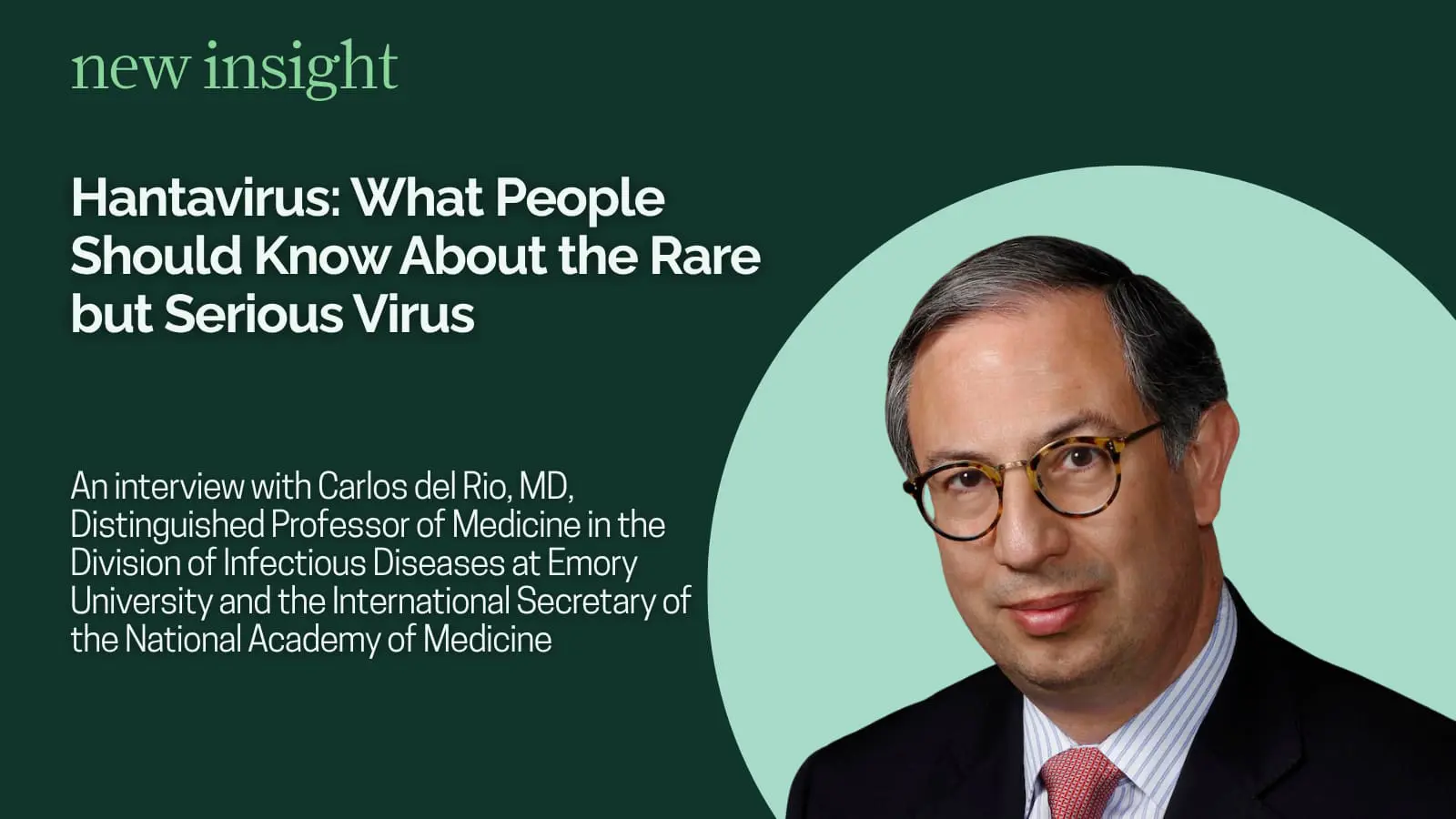
Interview by Laura DeStefano
After several passengers aboard a cruise ship bound from South America were diagnosed with hantavirus in May 2026, public concern quickly grew around the rare but potentially deadly disease — particularly after suggestions that passengers were infected by the Andes strain of the virus. This strain is one of the few hantaviruses associated with limited human-to-human transmission.
To better understand the level of risk, we spoke with Carlos del Rio, MD, Distinguished Professor of Medicine in the Division of Infectious Diseases at Emory University and the International Secretary of the National Academy of Medicine. In this interview, del Rio explains what hantavirus is, how it spreads, why the Andes strain has drawn attention, and why experts say the average American should not panic. He also discusses what hantavirus reveals about the broader challenge of emerging infectious diseases in a changing world.
This interview has been edited for length and clarity.
To start at the most basic level, what is hantavirus?
Hantavirus is not a single virus, but rather a family of viruses that primarily infect rodents. Humans are considered “incidental” hosts, meaning they are not the virus’ usual target. There are two broad categories of hantaviruses: the “Old World” type, which is mostly found in Europe and Asia and can cause hemorrhagic fever with renal syndrome (kidney involvement), and the “New World” type, which is found in North and South America and is associated with hantavirus pulmonary syndrome, a severe respiratory illness. The Andes strain is a New World type.
Each strain of hantavirus has a specific rodent host. The primary host of the Sin Nombre virus, which is responsible for the majority of hantavirus pulmonary syndrome cases in North America, is the deer mouse (Peromyscus maniculatus). The long-tailed pygmy rice rat (Oligoryzomys longicuaudatus) serves as the reservoir for the Andes virus in South America.
What’s different about the Andes strain?
The Andes strain, found primarily in southern Chile and Argentina, is unusual because it’s the only strain of hantavirus capable of human-to-human transmission.
Researchers still do not fully understand why the Andes strain behaves differently. Evidence suggests transmission requires close or prolonged contact, but there have been outbreaks in which people with relatively limited exposure also became infected. Fortunately, these outbreaks have remained small and relatively contained.
How do people get infected?
People usually become infected after inhaling viral particles found in the urine, droppings, or saliva of infected rodents. The virus enters through the lungs and begins to replicate in the body. One unusual aspect of hantavirus is that it can have a very long incubation period. While most cases develop symptoms between 14 and 17 days after infection, the incubation period can be as long as 8 weeks. That is why passengers from the cruise ship are being asked to quarantine for such a long time.
What are the symptoms and how is it treated?
Early symptoms can resemble the flu: fever, headaches, fatigue, and muscle aches. But in more severe cases, the illness can progress rapidly to shortness of breath and respiratory failure as the virus disrupts the barrier between the lungs and the bloodstream, allowing fluid to leak into the lungs.
The mortality rate for hantavirus pulmonary syndrome can reach up to 50 percent, depending on whether patients have access to advanced medical care like ICUs and mechanical ventilation. Part of the reason it’s so dangerous is that there is no specific antiviral treatment or approved vaccine.
Should the average person in the United States be worried about catching hantavirus?
For most Americans, the risk is extremely low. Hantavirus cases in the United States are rare — generally only a few dozen cases are reported each year. Most infections occur in rural areas of the Southwest, including parts of New Mexico and Arizona.
This cruise ship outbreak will not be “the next COVID.” Hantavirus is very difficult to transmit from person to person, which fundamentally limits its pandemic potential. Respiratory viruses that spread easily between humans are the ones public health experts worry about most when it comes to global pandemics.
That said, scientists are very interested in this outbreak as it offers the opportunity to better understand transmission and the natural history of the infection. Understanding how these viruses behave helps prepare us for future outbreaks.
Is there anything people can do to protect themselves?
The most important prevention strategy, if you live in an endemic area, is avoiding exposure to rodents and their droppings, especially in enclosed or poorly ventilated areas. People cleaning cabins, sheds, garages, or vehicles that may have rodent activity should wear gloves and masks, ventilate the area beforehand, and avoid sweeping or vacuuming dry droppings, which can aerosolize the virus.
Which viruses have greater pandemic potential than hantavirus?
Viruses such as avian influenza (bird flu) already have characteristics that make them more concerning from a pandemic perspective. They spread more efficiently, infect the respiratory tract, and have clearer pathways for human transmission. Novel respiratory viruses are always a major focus because people often have little or no preexisting immunity to them.
Is there a relationship between climate change and animal-to-human virus transmission?
Yes. Climate change and environmental disruption are altering where animals live and how humans interact with them. Rodent populations and habitats can shift as temperatures and ecosystems change, potentially bringing disease-carrying animals into new areas.
We are likely to see more emerging infectious diseases in the future, which is why continued surveillance and research remain so important.
What is the broader lesson from hantavirus and other emerging infections?
The biggest lesson is that new infectious diseases can emerge unexpectedly. COVID-19 reminded the world how quickly a novel pathogen can spread. We had no idea that was coming.
So, even if a disease currently poses only a low risk to the general public – like hantavirus – scientists and public health officials still need to monitor it carefully, so we are prepared for whatever comes next.
Read the latest insights from the NAM community.
Laura DeStefano is the Director of Strategic Communications & Engagement at the National Academy of Medicine and a science communicator.