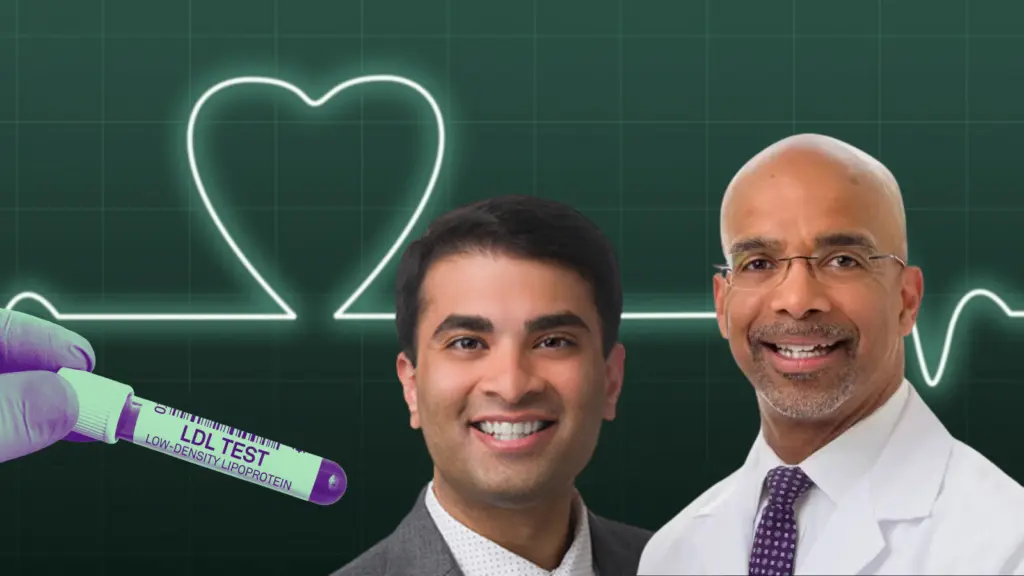
NAM Member Clyde W. Yancy, MD, MSc and NAM Fellow Nilay S. Shah, MD, MPH discuss what the new cholesterol guidelines mean for patients and how we understand cardiovascular risk.
Interview by Laura DeStefano
In March 2026, the American College of Cardiology and the American Heart Association released updated cholesterol management guidelines that reshape the prevailing wisdom for preventing heart attacks and strokes. The recommendations reflect major advances in scientists’ understanding of cardiovascular risk, emphasizing a personalized approach beginning at a younger age and reduction of cumulative, lifetime exposure.
To understand what the new guidelines mean for people of all ages, we spoke with NAM member Clyde W. Yancy, MD, MSc, and NAM fellow Nilay S. Shah, MD, MPH, both cardiologists who study, teach, and treat patients at Northwestern Medicine in Chicago, IL.
This interview has been edited for length and clarity.
Could you outline some of the key takeaways from the new guidelines?
Yancy: The guidelines now apply to people as young as 30. There are three different targets for optimal low-density lipoprotein (LDL) levels: 90 mg/dL for people without cardiovascular disease, 70 mg/dL for people with significant risk factors, and 55 mg/dL for people with existing disease.
The guidelines recommend additional screenings to get a more complete picture of someone’s risk so the right LDL target can be identified. This includes screenings for lipoprotein(a), or Lp(a), an independent risk factor for heart disease that isn’t measured in standard cholesterol tests, and Apolipoprotein B (ApoB), which can identify residual risk after LDL is optimized.
Finally, the guidelines endorse not only statins but also non-statin therapies to lower LDL. But the first steps are lifestyle modification, including diet and activity.
The update seems to be getting a lot of attention in the press and on social media. Why is that?
Yancy: This is a paradigm shift. There’s been an evolution in science and technology that allows us to prevent heart attacks and strokes better than ever before.
We’re beginning at an early age. We’re screening everyone in the population at least once, not just selected individuals. We’re calculating risk more precisely and accurately to identify the target cholesterol levels for each person that will have the most preventive effect. One size doesn’t fit all.
Shah: These guidelines are very actionable. There are a lot of strategies that can be taken directly from the document and implemented in the clinic in a direct and immediate way. For instance, there’s a new risk calculator that’s much more accurate than earlier tools. There are goal LDL cholesterol numbers to aim for, depending on a patient’s starting level of risk.
What new discoveries or research prompted the change in guidelines?
Yancy: There are several major insights that led us to where we are now. The first is the concept of “residual risk.” We had patients who had stopped smoking, controlled their blood pressure, and reduced their LDL below 90 mg/dL, but they were still having cardiac events. This forced us to explore what else could be causing disease, which is why we now recommend testing for Lp(a) and ApoB, which are additional risk factors for atherosclerosis.
We also identified new therapies. Through the Dallas Heart Study, we discovered that people with an inherited mutation in the PCSK9 gene were seemingly protected from coronary disease. That contributed to the development of new drugs called PCSK9 inhibitors. We found that when we prescribe these medicines on top of statin therapy, we see an even greater reduction in not only LDL levels, but also cardiovascular events.
Shah: There’s also the concept of “cumulative exposure,” which means we care not only about what your cholesterol numbers are now, but also about how long your body has been exposed to those numbers over time. That’s what leads to the accumulation of risk for heart disease.
The other big shift is the idea of matching the intensity of preventive efforts to the degree of risk. That idea has been around for two or three decades, but only recently have we developed an exceptionally accurate way to estimate someone’s likelihood of experiencing heart disease in their lifetime (the American Heart Association’s PREVENTTM Online Calculator) and identify the people most likely to benefit from an intensive prevention regimen.
The risk calculator is based on data from several million individuals across the US, from multiple backgrounds and multiple risk profiles, and it consistently shows excellent validation in predicting someone’s risk in the next 10 to 30 years. It’s a precision approach to prevention.
How would you advise people who are middle-aged or older and haven’t been managing their cholesterol with cumulative exposure in mind? Is it too late to prevent disease?
Shah: To borrow an adage, the best time to do something about your cholesterol was when it started increasing, but the second-best time is now. I tell my patients that although this is important and there is some urgency, it’s not an emergency. You don’t have to rush off and talk to your doctor tomorrow. But it’s worth having a conversation at your next visit about options to mitigate your heart disease risk, no matter how old you are or what your risk factors may be. In other words, it’s never too late.
Cholesterol is important, but it’s not the only thing that’s important. Risk comes from many places, including blood pressure and blood sugar, events in your medical history, your family history, and whether or not you smoke.
Sleep is also a very important factor with respect to heart health and prevention. We need to focus on mitigating your overall risk.
Yancy: One of the issues that’s top of mind right now is the influence of coexisting inflammation, along with high triglycerides (too much fat in the blood), and oxidative stress. These are important categories that probably drive events as well, but we can’t yet fully manipulate them. And the big unspoken risk today is medical obesity.
What about alcohol? Is the science clear on how drinking affects heart health?
Yancy: We used to think that small amounts of alcohol had a protective effect. But that was a confounded observation. It turns out that when we rigorously controlled for other lifestyle factors, especially income, in the original data, the impact of alcohol was infinitesimally small.
The beneficial nutrients you can find in alcohol — like resveratrol — can also be found in fruits and vegetables. Eat some grapes, and you’re there. Drinking alcohol is a personal choice, but don’t drink because you think it’s going to lower your risk for heart disease.
Shah: I think the field as a whole is moving away from supporting alcohol consumption. We don’t have the most rigorous studies yet, but the writing is on the wall. In my opinion, the data essentially tell us that no alcohol is the best option for heart health and health overall.
What do the guidelines mean for people with LDL levels labeled as “borderline”?
Yancy: We need to dismiss the idea of borderline cholesterol. The lower the better, period.
With this paradigm shift, we are thinking about 30-year risk models. Do you really want your arteries bathed in “borderline” cholesterol for the next 30 years, waiting for the moment it gets bad enough to treat? I think we have done more harm than good by depicting things like blood pressure and cholesterol as borderline values. The lower the better for blood pressure, the lower the better for cholesterol.
Should any groups of people pay special attention to these guidelines?
Yancy: Communities of African ancestry continue to carry a disproportionate risk for heart disease because of their high rates of hypertension, which plays an important role in cardiovascular disease alongside cholesterol. We’re also learning that cardiovascular complications or other adverse events during pregnancy, such as preeclampsia, are associated with a higher risk for heart conditions over time, so women who have experienced this require a different longitudinal framing of risk.
Shah: Part of my research is focused on people of South Asian ancestry. They’re not the largest group in the US demographically, but they experience higher rates of heart disease than other populations, and at younger ages.
I’m also interested in shifting the conversation to younger people. People who are 18 to 40 are arguably the least connected to the health care system because they’ve aged out of seeing a pediatrician and are generally healthy adults. But based on our epidemiologic data, this age group represents the prime time that prevention can have its biggest effect. So, I’m interested in learning how to intervene, especially using novel messaging, and help people maintain good health before they lose it.
There’s an opportunity to prevent heart disease at even younger ages, too — like infancy and adolescence and even as early as in utero. Data show us that people born from pregnancies with complications like hypertension or gestational diabetes may have elevated risk for poor health across their lifetime. It’s not a guarantee, but it sets the stage. This is part of an emerging concept of intergenerational transfer of cardiovascular risk.
Prevention can be a “tough sell” because you can’t measure events that don’t happen. How do you counsel patients about the benefits of a preventive approach to cholesterol management?
Shah: I tell my patients that if we are successful, they will experience nothing. We’ll never really know whether we prevented a heart attack that they were going to have. But it’s still worth it.
People are actually receptive to hearing that there are no guarantees. I say this as someone who is a clinician but also as someone who’s been on the patient side of things with friends and family. There’s more respect for uncertainty when the clinician is upfront about it.
I recommend what I think will give you the best opportunity to be healthy and do what you enjoy doing. I don’t have a crystal ball. I can’t and won’t promise a particular outcome, but we can work together to put you in the best possible position.
Yancy: Dr. Shah just said something very important. Decades ago, when I was educated, we took a very paternalistic approach to medicine. A patient would come to see me, and I would tell them what they needed to do and what would happen if they did it.
I think paternalism in medicine was a fallacy. It has generated a false sense of certainty on one hand and a false sense of security on the other. We have to develop partnerships with patients and bring them into the thought process and decision making. That’s the only way these guidelines will be effective.
We also have to acknowledge that some people are skeptical about the health care system’s motives. They believe the companies that make the drugs have monopolized the data to drive uptake of their products. There is also concern about unrecognized side effects – especially from statins (known side effects are muscle aches and pains).
I don’t declare any patient’s point of view to be wrong. I listen and say, let me give you an alternative view. Importantly, we have a conversation. That’s the starting point. When we allow space for people to state whatever it is they believe, however they want to state it, and when we provide an alternative approach without it being confrontational, we begin to build trust. And with trust, change can happen.
Read the latest insights from the NAM community.
Laura DeStefano is the Director of Strategic Communications & Engagement at the National Academy of Medicine and a science communicator.