
Addressing Major Sources of Carbon Emissions for N95 Filtering Facepiece Respirators

Category: Disposable PPE

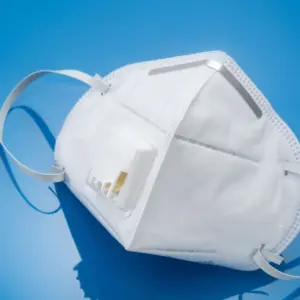
Disposable face masks are personal protective equipment (PPE) commonly made from single-use plastics and other disposable materials. N95 filtering facepiece respirators (FFRs) are a typical product in this category, primarily made of polyester and polypropylene, with smaller components made of aluminum and steel. Other types of disposable PPE include face shields and gowns. N95 respirators are classified as regulated medical waste and are processed through infectious waste incinerators.

This brief summarizes a carbon footprinting study of a single-use N95 respirator to identify typical hotspots and potential interventions to decrease product emissions.

Carbon Emissions Across Life Cycle

The major hotspot for the N95 respirator is manufacturing, specifically of the non-woven polypropylene and polyester. Additional hotspots are energy use, extraction of crude oil, and emissions from raw material production.

The masks are assumed to be incinerated at end-of-life, accounting for one-fourth of total emissions. Reprocessing N95 respirators instead can reduce their carbon footprint by 50-65%, depending on the decontamination method used. Packaging and transportation make negligible contributions.


Focusing on Carbon Hotspots

The most impactful interventions focus on extending the lifetime and improving manufacturing of disposable N95 respirators. Based on these results, specific suggestions for different stakeholders include:

1. Extend the use of N95 respirators to reduce waste:
☑ Reprocess N95 respirators.
$ Consider modular respirator designs with replaceable filters.
⚙ Design improvements toward fully reusable alternatives and longer-lasting models.

2. Improve end-of-life processes:
☑ Explore alternate methods to incineration such as decontamination and disposal.

3. Reduce emissions associated with materials and manufacturing:
$ Procure low-carbon polyester from suppliers.
⚙ Use bio-based polymers or materials with a lower carbon footprint
.
⚙ Optimize cutting and forming processes to reduce waste material.
⚙ Procure renewable electricity for manufacturing operations.

Audience Key:  Clinicians | ☑  Administration | ⚙ Manufacturers | $ Procurement | ⛑ Regulators


Reference: Tao et al. 2021. “Can Decontamination and Reuse of N95 Respirators during COVID-19 Pandemic Provide Energy, Environmental, and Economic Benefits?” Applied Energy 304: 117848.

This resource was prepared by Mathew Eckelman (Northeastern University) and Nazneen Rahman (Sustainable Medicines Partnership), who are members of the Health Care Supply Chain Working Group of the NAM Climate Collaborative; and reviewed by members of the Collaborative. Statements in this resource do not necessarily reflect the views of all members of the Climate Collaborative; the NAM; or the National Academies of Sciences, Engineering, and Medicine (National Academies). The resource is intended to help inform and stimulate discussion. It is not a report of the NAM or the National Academies. Copyright by the National Academy of Sciences. All rights reserved.
Secret Link