Closing the Deal: Financing Our Security Against Pandemic Threats
Report of the G20 High-Level Independent Panel
COVID-19 upended societies and economies across the world, starkly demonstrating the need for all nations to invest in pandemic prevention, preparedness, and response (PPR). At the same time major drivers of pandemic risk are rising, and epidemics are occurring at higher frequency, with more severity, and with broader potential for global impact. The pandemic of tomorrow is not a theoretical risk – it can happen at any time. However, despite these rising risks, countries are still grossly under-invested in pandemic preparedness and response.
To advance an international strategy to marshal resources, coordination, and political will for PPR financing, the G20 South African Presidency convened the High-Level Independent Panel on Financing the Global Commons for Pandemic Preparedness and Response with the U.S. National Academy of Medicine as Secretariat. The Panel’s 2025 report, Closing the Deal: Financing Our Security Against Pandemic Threats, recommends five solutions to expand access to medical countermeasures during public health emergencies and strengthen the financing and mobilization of domestic resources for pandemic preparedness.
Report
Closing the Deal: Financing Our Security Against Pandemic Threats
The G20 High Level Independent Panel sets minimum annual benchmarks for pandemic financing and urges governments to take action by or before the September 2026 United Nations High-Level Meeting on Pandemic Prevention, Preparedness, and Response.
Background
The G20 Italian Presidency originally convened the High-Level Panel on Financing the Global Commons for Pandemic Preparedness and Response in 2021. The Panel’s first report, A Global Deal for Our Pandemic Age, identified four major gaps in PPR and proposed nine solutions. Following the report’s publication, the G20 established the Joint Finance and Health Ministers Task Force and the Pandemic Fund at the World Bank, which has supported nearly 50 projects across 75 low- and middle-income countries. In 2025, member states of the World Health Organization adopted the Pandemic Agreement to strengthen PPR, and the updated International Health Regulations were amended to include provisions that speed the international response to public health emergencies. Yet, significant challenges remain, particularly as official development assistance funds are dwindling worldwide.
Recommendations and Benchmarks


Report Highlights
Recommendations and Benchmarks
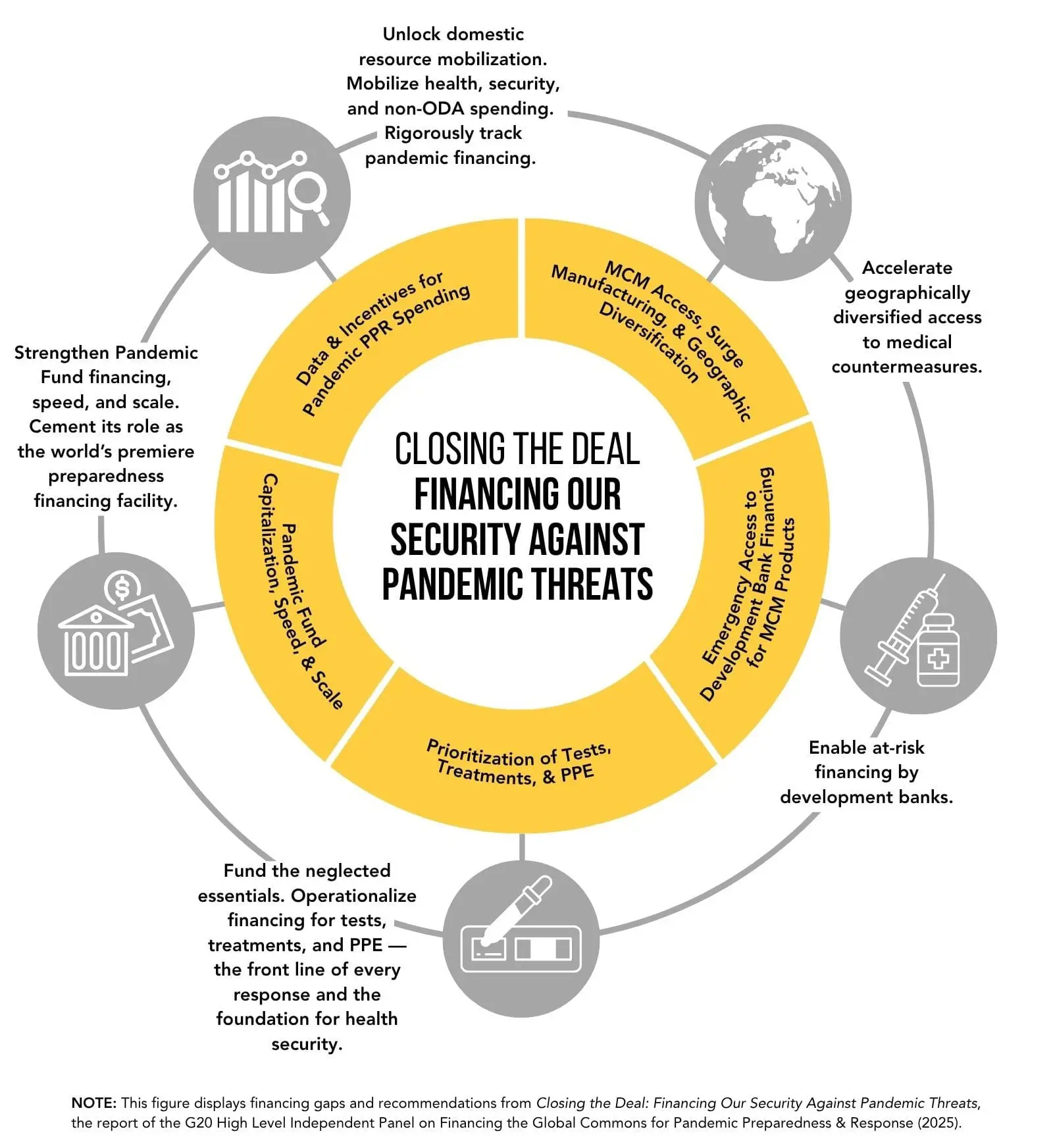
1. Unlock domestic resource mobilization. Mobilize health, security, and non-ODA (official development assistance) spending. Rigorously track results.
At the UN HLM, all governments should present prioritized, costed PPR plans and announce new PPR financing, funded through a mix of domestic resources—like a dedicated portion of transport fees and health taxes as well as biosecurity spending—and international financing. Direct bilateral ODA and/or MDB financing for civil society organizations should be accelerated where governments lack presence or capacity to enhance PPR financing in fragile settings. Ahead of the UN HLM, the G20 JFHTF should launch an annual Global Pandemic Spending Tracker* covering country, MDB, PDB, and private sector financing across health, security, and development budgets toward the minimum benchmarks below.
2. Accelerate geographically diversified access to MCMs (medical coutermeasures).
Ahead of the 2026 UN HLM, the IFC and other DFIs should partner to launch and finalize at least one dedicated, blended MCM surge financing facility and an associated ‘standby’ list of regional manufacturers and pooled procurement mechanisms for each region. Linked to that effort, philanthropies should launch a designated operational platform for technical assistance, market assessments, and stress testing to expand the list of regional manufacturers, particularly for under-invested products like diagnostics, PPE, and biomanufacturing. This facility should fill a key financing gap in the private sector, coordinate among like-minded actors as a partnership program, and leverage ongoing design work among G7 and G20 DFIs, IFC, and partners under the MCM Surge Financing Initiative, ensuring rapid deployability by 2026.
3. Enable development bank at-risk financing for MCM advance purchases.
Ahead of the 2026 UN HLM, all MDBs and relevant PDBs should confirm and clearly communicate the availability of rapid and effective at-risk financing for advance purchases of MCMs by LMICs during epidemics and pandemics (i.e. borrowing to purchase promising candidate MCMs before regulatory approval). At-risk financing should apply explicitly to country-level loans as well as any pooled procurement mechanisms using the development bank balance sheets. WHO PQ and NRA approvals must be accelerated and products that have already received regulatory approval by WHO-Listed Authorities at ML3 or higher should be given provisional or temporary approvals until WHO and NRA approvals are completed.
4. Operationalize financing for tests, treatments, and PPE
Ahead of the 2026 UN HLM, global and regional organizations should designate specific international and regional anchor institutions to coordinate the development and scale-up of tests, treatments, and PPE; launch a financing strategy to prioritize and expand investments for specific epidemic and pandemic threats, leveraging the MCM Surge Financing Facility outlined in Recommendation 2 as well as other existing blended finance mechanisms; and identify and support at least one PPE manufacturing hub in each region with regional stockpiles, including for long shelf-life products such as elastomeric respirators.
5. Strengthen the Pandemic Fund financing, speed, and scale. Cement its role as the world's premier preparedness financing facility.
Ahead of the 2026 UN HLM, the G20 and other countries should commit to sustainably capitalize and strengthen the speed and scale of the Pandemic Fund. The World Bank and other MDBs should commit to using their tools and establishing standing allocations to ensure renewable support for the Pandemic Fund and its work. The Pandemic Fund should double down on its core preparedness mandate as well as its role in tackling cross-border threats, catalyzing domestic and non-ODA resources, soliciting matching funding, enhancing access for civil society implementers in fragile settings, and partnering more systematically with MDBs to leverage their lending.
Graphic representation

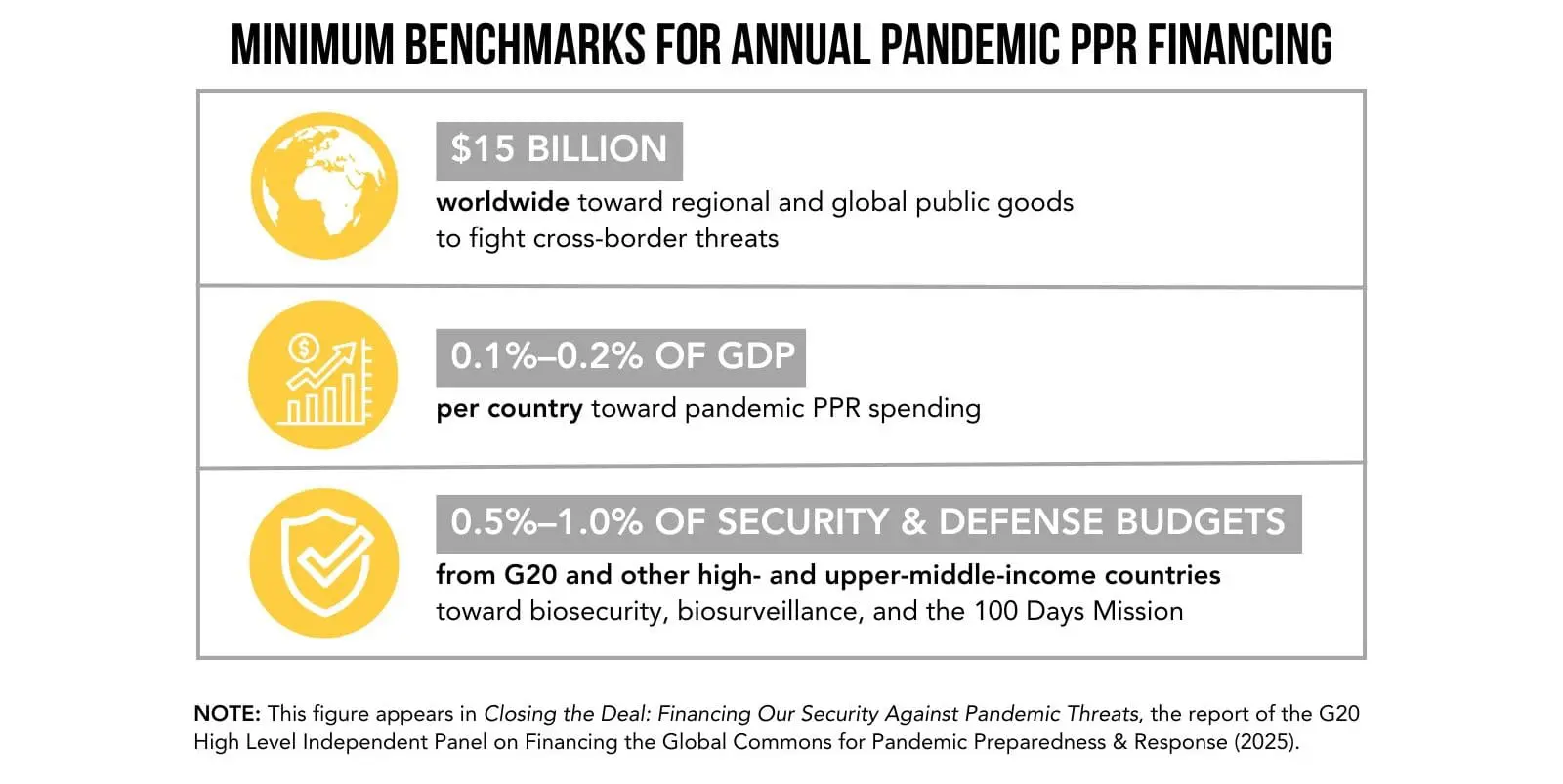
Minimum benchmarks for annual pandemic PPR financing
- At least $15 billion annually in international financing directed toward regional and global public goods to fight cross-border threats.
- At least 0.1% to 0.2% of GDP per year, per country, directed toward pandemic PPR spending, informed by the recent analysis from the WHO, OECD, and the World Bank.
- At least 0.5% to 1.0% of security and defense budgets per year from G20 and other high- and upper-middle-income countries (HICs and UMICs) directed toward biosecurity, biosurveillance, and the 100 Days Mission to support deterrence, operational resilience, and to prevent deliberate and accidental misuse of biological agents—at home and globally.

We thank Working Group co-leads, members, and colleagues and Working Group members at the RAND Center for AI, Security, and Technology for insights and analysis that contributed to the development of these minimum benchmarks, as well as colleagues and analyses referenced by the OECD, WHO, and World Bank.
Panel Members
Secretariat
Special Advisor
Previous Report
A Global Deal for Our Pandemic Age
Report of the G20 High Level Independent Panel on Financing the Global Commons for Pandemic Preparedness and Response
Foreward
The High Level Independent Panel was asked by the G20 in January 2021 to propose how finance can be organized, systematically and sustainably, to reduce the world’s vulnerability to future pandemics1.
Our report sets out critical and actionable solutions and investments to meet the challenge of an age of pandemics, and to avoid a repeat of the catastrophic damage that COVID-19 has brought. The Panel arrived at its recommendations after intensive deliberations and consultations with a wide range of stakeholders and experts around the globe over a period of four months. We urge that our proposals be discussed, developed further, and implemented as a matter of urgency.
Scaling up pandemic preparedness cannot wait until COVID-19 is over. The threat of future pandemics is already with us. The world faces the clear and present danger of more frequent and more lethal infectious disease outbreaks. The current pandemic was not a black swan event. Indeed, it may ultimately be seen as a dress rehearsal for the next pandemic, which could come at any time, in the next decade or even in the next year, and could be even more profoundly damaging to human security.
The world does not lack the capacity to limit pandemic risks and to respond much more effectively than it has responded to COVID-19. We have the ideas, the scientific and technological resources, the corporate and civil society capabilities, and the finances needed.
Our collective task must be to better mobilize and deploy these resources to sharply reduce the risk of future pandemics, and the human and economic damage they bring. This will require whole-of-government and whole-of society responsibilities, not only those of health authorities and medical scientists. It will mean thinking internationally, not just domestically. It must also involve bolstering multilateralism, not only bilateral initiatives.
Most fundamentally, investing collectively to prevent infectious disease outbreaks, and to ensure that large swathes of the world’s population are not left ill-equipped to respond when a pandemic strikes, is in the mutual interests of all nations, not only a humanitarian imperative in its own right.
In short, we need a global deal for our pandemic age. We must strengthen global governance and mobilize greater and sustained investments in global public goods, which have been dangerously underfunded. Both are critical to building resilience against future pandemics.
It requires establishing a global governance and financing mechanism, fitted to the scale and complexity of the challenge, besides bolstering the existing individual institutions, including the WHO as the lead organization.
The economic case for the investments we propose is compelling. They will materially reduce the risk of events whose costs to government budgets alone are 300 times as large as the total additional spending per year that we propose, and 700 times the annual additional international investments. The full damage of another major pandemic, with its toll on lives and livelihoods, will be vastly larger.
In a historically unprecedented way, security for people around the world now depends on global cooperation. Acting and investing collectively for pandemic security, together with climate change, represents the primary international challenge of our times. Failure to establish the basis for international cooperation will make it almost impossible to address these existential challenges.
In closing, the Panel wishes to record how its thinking was enriched by others. As we are comprised mainly of economic and financial experts, we benefited significantly from extensive consultations with the global health community, including the major international organizations, the medical science community, the private sector, and philanthropic and civil society organizations with deep engagements in the field. The Global Preparedness Monitoring Board, in particular, provided the Panel with a comprehensive assessment of requirements for pandemic prevention, preparedness and response. We also drew on the insights of the top management and staff of the International Financial Institutions and leading economic and financial professionals2.
The Panel’s thinking is broadly aligned with that of the Independent Panel for Pandemic Preparedness and Response (IPPPR) which published its report in May 2021, and with whose members we had very informative discussions. We also gained insights from interactions with the Pandemic Preparedness Partnership, the Pan-European Commission on Health and Sustainable Development, and the Lancet COVID-19 Commission.
The Panel’s work would not have been made possible without the expert knowledge and analysis of our Project Team, constituted by Bruegel and the Center for Global Development, and the timely and efficient coordination by the Administrative Secretariat drawn from the US National Academy of Medicine and the Wellcome Trust.
Finally, we extend our appreciation to the G20 under its Italian Presidency for leadership in convening this important review, and are committed to supporting further discussion of our proposals. We harbor hope that the grim lessons from this crisis will catalyze the collective political will and ambition needed to prevent such a deadly and costly pandemic from happening again.
| Tharman Shanmugaratnam* | Lawrence Summers* | Ngozi Okonjo-Iweala* |
| Ana Botín | Mohamed El-Erian | Jacob Frenkel |
| Rebeca Grynspan | Naoko Ishii | Michael Kremer |
| Kiran Mazumdar-Shaw | Luis Alberto Moreno | Lucrezia Reichlin |
| John-Arne Røttingen | Vera Songwe | Mark Suzman |
| Tidjane Thiam | Jean-Claude Trichet | Ngaire Woods |
| Zhu Min | Masood Ahmed# | Guntram Wolff# |
| Victor Dzau (Advisor) | Jeremy Farrar (Advisor) |
* Co-Chairs
# Project Directors
1. The membership of the Panel, Project Team and Administrative Secretariat of the G20 High Level Independent Panel (HLIP) on Financing the Global Commons for Pandemic Preparedness and Response is at Annex A. The Panel’s terms of reference are at Annex B.
2. A non-exhaustive list of persons consulted is at Annex C.
High Level Summary
We are in an age of pandemics. COVID-19 has painfully reminded us of what SARS, Ebola, MERS and H1N1 had made clear, and which scientists have repeatedly warned of: without greatly strengthened proactive strategies, global health threats will emerge more often, spread more rapidly, take more lives, disrupt more livelihoods, and impact the world more greatly than before.
Together with climate change, countering the existential threat of deadly and costly pandemics must be the human security issue of our times. There is every likelihood that the next pandemic will come within a decade – arising from a novel influenza strain, another coronavirus, or one of several other dangerous pathogens. Its impact on human health and the global economy could be even more profound than that of COVID-19.
The world is nowhere near the end of the COVID-19 pandemic. Without urgent and concerted actions and significant additional funding to accelerate global vaccination coverage, the emergence of more variants of the virus is likely and will continue to pose a risk to every country. The solutions for vaccinating the majority of the world’s population are available and can be implemented within the next 12 months. More decisive political commitments and timely follow-through will resolve this disastrous global crisis.
The world is also far from equipped to prevent or stop the next pandemic. Lessons from COVID-19, on how the world failed to prevent the pandemic, why it has been prolonged at such catastrophic cost, and how we can overcome the crisis if we now respond more forcefully, provide important building blocks for the future. We must use this moment to take the bold steps needed to avoid the next pandemic, and not allow exhaustion from current efforts to divert attention from the very real risks ahead.
Plugging Four Major Gaps
Making the world safer requires stepped-up and sustained national, regional and global actions and coordination, leveraging fully the private sector, to prevent outbreaks as well as to respond much faster, more equitably and more effectively when a pandemic emerges. We must plug four major gaps in pandemic prevention, preparedness and response:
- Globally networked surveillance and research: to prevent and detect emerging infectious diseases
- Resilient national systems: to strengthen a critical foundation for global pandemic preparedness and response
- Supply of medical countermeasures and tools: to radically shorten the response time to a pandemic and deliver equitable global access
- Global governance: to ensure the system is tightly coordinated, properly funded and with clear accountability for outcomes
Investing in Global Public Goods: To Save Immense Costs
We can only avoid future pandemics if we invest substantially more than we have been willing to spend in the past, and which the world is now paying for many times over in dealing with COVID-19’s damage.
Countries must step up domestic investments in the core capacities needed to prevent and contain future pandemics, in accordance with the International Health Regulations. Governments will in many cases have to embark on reforms to mobilize and sustain additional domestic resources, so as to build up these pandemic-related capacities and strengthen public health systems more broadly, while at the same time enabling their economies to return to durable growth. Low- and middle-income countries will need to add about 1% of GDP to public spending on health over the next five years.
However, domestic actions alone will not prevent the next pandemic. Governments must collectively commit to increasing international financing for pandemic prevention and preparedness by at least US$75 billion over the next five years, or US$15 billion each year, with sustained investments in subsequent years.
The Panel assesses this to be the absolute minimum in new international investments required in the global public goods that are at the core of effective pandemic prevention and preparedness. The estimate excludes other investments that will contribute to resilience against future pandemics while benefiting countries in normal times. These complementary interventions – such as containing antimicrobial resistance, which alone will cost about US$9 billion annually, and building stronger and more inclusive national health and delivery systems – provide continuous value. Furthermore, the estimated minimum international investments are based on conservative assumptions on the scale of vaccine manufacturing capacity required in advance of a pandemic. Larger public investments to enable enhanced manufacturing capacity will indeed yield much higher returns.
The minimum additional US$15 billion per year in international financing for pandemic preparedness is still a significant increase. It is a critical reset to a dangerously underfunded system.
These investments are a matter of financial responsibility, besides being a scientific and moral imperative. They will materially reduce the risk of events whose costs to government budgets alone are 700 times as large as the additional international investments per year that we propose, and 300 times as large as the total additional investments if we also take into account the domestic spending necessary. The full damage of another major pandemic, with its toll on lives and livelihoods, will be vastly larger.
Crucially, this additional international funding must add to, and not substitute for, existing support to advance global public health and development goals. It would be short-sighted to scale up efforts for pandemic prevention and preparedness by reallocating multilateral or bilateral Official Development Assistance (ODA) resources from other development priorities, particularly given the likely lasting negative impacts of the current pandemic on economic and human development in low- and lower-middle-income countries. The threat of pandemics to our collective security warrants a new and more sustainable global financing approach, beyond traditional aid, to invest in global public goods from which all nations benefit.
Strengthening Global Governance of Health and Finance
However, money alone will not deliver a safer world without stronger governance. The current global health architecture is not fit-for-purpose to prevent a major pandemic, nor to respond with speed and force when a pandemic threat emerges. As the Global Preparedness Monitoring Board highlights, the system is fragmented and complex, and lacks accountability and oversight of financing of pandemic preparedness. We must address this by establishing a governance mechanism that integrates the key players in the global health security and financing ecosystem, with the World Health Organization (WHO) at the center.
To plug this gap, we propose establishing a new Global Health Threats Board (Board). The proposal builds loosely on the model of the Financial Stability Board, established by the G20 in the aftermath of the 2008 Global Financial Crisis and which has operated successfully as a collective to contain risks to the global financial system.
This new governance mechanism will bring together the worlds of health and finance. The Board should include Health and Finance Ministers from a G20+ group of countries and heads of major regional organizations, with leadership and membership that ensures credibility and inclusivity. It should have a permanent, independent Secretariat, drawing on the resources of the WHO and other multilateral organizations.
This new Board will complement the Heads of State/Heads of Government-level Global Health Threats Council that has been proposed by the Independent Panel for Pandemic Preparedness and Response (IPPPR), to be established by the UN General Assembly. The Panel supports the establishment of this top-level political leadership council, to mobilize the strong collective commitment required for global health security. The Board, on the other hand, will aim more specifically to match tightly networked global health governance with financing, which are both critical enablers to reduce pandemic risks. It should take reference from the initiatives and work of the proposed Global Health Threats Council, to ensure a complementarity of functions.
The Board would provide systemic financial oversight aimed at enabling proper and timely resourcing of capacities to detect, prevent and rapidly respond to another pandemic, and to ensure the most effective use of funds. It must join up the efforts of international bodies, with clearly delineated responsibilities that match their comparative strengths, and ensure that the system fully engages and leverages the capabilities of the private sector and non-state actors. The Board must also track global risks and outcomes, and ensure every country plays its part to enhance global health security.
The Key Strategic Moves
A transformed system, with stronger global financial governance, will require both greater resources for existing institutions, with enhanced mandates where necessary, and a new multilateral funding mechanism that will plug the major gaps in global public goods needed to reduce pandemic risks.
We must make four strategic moves.
First, nations must commit to a new base of multilateral funding for global health security based on pre-agreed and equitable contribution shares by advanced and developing countries. This will ensure more reliable and continuous financing, so the world can act proactively to avert future pandemics, and not merely respond at great cost each time a new pandemic strikes.
This must include a fundamentally new way of financing a reformed and strengthened WHO, so that it receives both enhanced and more predictable resources. The Panel joins the call by the IPPPR for assessed contributions to be increased from one-quarter to two-thirds of the budget for the WHO’s base program, which will effectively mean an addition of about US$1 billion per year in such contributions.
Second, global public goods must be made part of the core mandate of the International Financial Institutions (IFIs) – namely the World Bank and other multilateral development banks (MDBs), and the International Monetary Fund (IMF). They should draw first on their existing financial resources, but shareholders must support timely and appropriately sized replenishments of their concessional windows and capital replenishments over time to ensure that the greater focus on global public goods is not at the expense of poverty reduction and shared prosperity.
The IFIs are a potent but vastly under-utilized tool in the world’s fight against pandemics and climate change. The MDBs should partner with countries to incentivize and increase investments in pandemic preparedness and accelerate closing of critical health security gaps. This will require enhancing the grant element of their funding through dedicated concessional windows for pandemic preparedness. In this, they should partner with the grant-based global health intermediaries including Gavi and the Global Fund to Fight AIDS, Tuberculosis and Malaria, to leverage each other’s funding for investments that will strengthen health system resilience.
The IFIs should also provide swift, scaled-up access to funds in response to a pandemic, with relaxed rules on country borrowing and automatic access for pre-qualified countries. This should entail new or strengthened pandemic windows in the IMF and MDBs, and the authorization for MDBs to access additional market funding at the onset of a pandemic to finance a scaled-up response. To ensure that these official funds are used to counter the impact of the pandemic, the IMF, working with the relevant stakeholders, should propose a framework of pre-established rules for relief on debt servicing that involves the participation of all creditors in restructurings instituted in future pandemics.
Third, a Global Health Threats Fund mobilizing US$10 billion per year should be established, and funded by nations based on pre-agreed contributions. This new Fund, at two-thirds of the minimum of US$15 billion in additional international resources required, brings three necessary features into the financing of global health security. First, together with an enhanced multilateral component of funding for the WHO, it would provide a stronger and more predictable layer of financing. Second, it would enable effective and agile deployment of funds across international and regional institutions and networks, to plug gaps swiftly and meet evolving priorities in pandemic prevention and preparedness. Third, it would also serve to catalyze investments by governments and the private and philanthropic sectors into the broader global health system, for example through matching grants and co-investments. The Fund’s functions should be defined to ensure that it complements rather than substitutes for financing of the MDBs’ concessional windows and the existing global health organizations.
The new Fund should support the following major global actions:
- Building a transformed global network for surveillance of infectious disease threats. This will require a major scale-up of the network, combining pre-existing and new nodes of expertise at the global, regional and country levels, with the WHO at the center.
- Providing stronger grant financing to complement MDBs’ and the global health intermediaries’ support for country- and regional-level investments in global public goods.
- Ensuring enhanced and reliable funding to enable public-private partnerships for global-scale supply of medical countermeasures, so we can preclude severe shortages anywhere and avoid prolonging a pandemic everywhere. This added layer of funding will support a permanent network to drive end-to-end global supply, which builds on the lessons learned from the ACT-Accelerator coalition.
- Supporting research and breakthrough innovations that can achieve transformational change in efforts to prevent and contain future pandemics, complementing existing R&D funding mechanisms like the Coalition for Epidemic Preparedness Innovations (CEPI).
The Fund will be structured as a Financial Intermediary Fund (FIF) at the World Bank, which will perform the treasury functions, similar to how it hosts other international arrangements like the Global Environment Facility. Governance of the Fund will be independent of the World Bank, under an Investment Board, which could also be constituted as a committee of the Global Health Threats Board, which will determine the priorities and gaps to be addressed by the Fund.
Fourth, multilateral efforts should leverage and tighten coordination with bilateral ODA, and with the private and philanthropic sectors. Better coordination within country and regional platforms will have greater impact in reducing pandemic risks, and enable better integration with ongoing efforts to tackle endemic diseases and develop other critical healthcare capabilities. It will be important to ensure that ODA flows mobilized for pandemic preparedness add to and do not divert resources from other priority development needs.
There is significant scope for governments and the MDBs to mobilize private sector resources for pandemic preparedness and response, especially in developing global-scale capacity for critically-needed supplies, from testing kits and vaccines to oxygen cylinders and concentrators, as well as the whole delivery infrastructure needed within countries. The public sector should also grow partnerships with philanthropic foundations to substantially expand research on infectious disease threats and breakthrough countermeasures. This could include efforts to de-risk early-stage R&D and other high-risk investments, in order to attract private institutional investors.
Significant progress is within reach in the next five years. Strong and sustained political commitment, a recognition of the mutual interests of nations in health security, and long-term financing will be essential.
The collective investments we propose, with equitable contributions by all nations, are affordable. They are also miniscule compared to the US$10 trillion that governments have already incurred in the COVID-19 crisis.
We must invest without delay. It will be a huge error to economize over the short term and wait once again until it is too late to prevent a pandemic from overwhelming us. The next pandemic may indeed be worse.
Key Proposals and Roadmap
| Proposal number | Proposal | Key Action Items | Main Actors | Timeline |
| 1a | Establish a Global Health Threats Board for systemic financial oversight, to ensure enhanced and predictable global financing for pandemic PPR and effective use of funds. | i. Develop a charter for the Board including detailed mandate, composition and governance ii. Establish the Board with a permanent, independent Secretariat. iii. Identify early priorities for funding by the Global Health Threats Fund (see item 2 below). | G20 | Q4 2021* |
| 1b | A minimum of US$15 billion per year in new international financing is required for effective pandemic prevention and preparedness. | Q4 2021* | ||
| 1c | Establish an independent scientific advisory panel to provide system-wide analysis of emerging health threats and advice based on the best available science. | iv. The scientific advisory panel can be formed by transforming the Global Preparedness Monitoring Board (GPMB) to take on this function. | GPMB | Q2 2022 |
| 1d | Establish a Health Security Assessment Program (HSAP), to provide in-depth assessments of countries’ pandemic prevention and preparedness capabilities and investments. | v. The HSAP should be coordinated by the WHO and the World Bank, with the outcomes of this assessment reflected in IMF Article IV reports. | WHO, World Bank, IMF | Q4 2022 |
| 2 | Establish a Global Health Threats Fund. This would be a dedicated fund mobilizing US$10 billion per year, based on preagreed contributions, to support investments in global public goods for pandemic PPR. This new multilateral funding mechanism will enable effective and agile deployment across existing institutions and networks, and help catalyze financing for the broader global health system. It would serve to support a few major global actions: a. Building a transformed global network for surveillance of infectious disease threats. b. Providing stronger grant financing to complement MDBs’ and the global health intermediaries’ support for country- and regional-level investments in global public goods. c. Ensuring enhanced and reliable funding to enable public-private partnerships for rapid development, manufacturing and delivery of medical countermeasures on a global scale. d. Supporting research and breakthrough innovations that can achieve transformational change in efforts to prevent and contain future pandemics, complementing existing R&D funding mechanisms like CEPI. | i. Establish a Global Health Threats Fund structured as a Financial Intermediary Fund (FIF) at the World Bank, with governance independent of the World Bank. ii. Kickstart the Fund with direct contributions by G20 and other governments, ideally in amounts equivalent to an assessed contribution scheme, as well as philanthropic and corporate contributions. | G20 | Q4 2021* For (i), to initiate early discussions with the World Bank on establishing the FIF. |
| 3 | Develop resilient domestic finances for prevention and preparedness. Governments working with international institutions must embark on a major agenda of reforms to mobilize domestic resources on a sustained basis so as to enable investments in the key capacities required to avoid future outbreaks and strengthen national health systems, while enabling their economies to return to durable growth. Low- and middle-income countries will need to add about 1% of GDP to public spending on health over the next five years. | i. Scale up national capabilities for surveillance, detection, and containment of any new outbreaks. ii. National governments and International Financial Institutions (IFIs) to jointly develop a plan for more resilient tax revenues. iii. Define and track budgetary expenditures on outbreak prevention and preparedness. iv. Develop and implement costed national action plans for health security, with Finance and Health Ministries as full partners in this effort, including human resources development, performance-based budget policies and matching fund schemes. v. Ensure necessary external financial assistance to complement national domestic financing. | National governments, with support from WHO, IFIs and OECD | Medium Term To undertake learning around COVID-19, and upgrade National Action Plans for Health Security (NAPHS) by 2022, with clear implementa-tion timelines over the medium term. |
| 4 | Strengthen financing for the WHO and One Health, and put it on more predictable footing. Greater and more predictable funding is necessary for the WHO to perform its critical functions and ensure that there are no gaps in the surveillance-to-action loop, and to strengthen the integrated One Health approach. | i. Enhance the share of multilateral funding for the WHO through increased assessment-based contributions – with assessment-based core contributions from Member States increased to two-thirds of the budget for the WHO base program, and an organized replenishment process for the remainder of the budget. ii. Support WHO, OIE, FAO and UNEP in their integrated One Health approach. | WHO Sustainable Financing Working Group, World Health Assembly | Q2 2022 |
| 5 | Make financing of global public goods part of the core mandate of World Bank and other MDBs. The MDBs should incentivize investments in pandemic prevention and preparedness at the country and regional levels, with grants and greater concessionality that complement existing results-based and programmatic lending. They should draw first on their existing financial resources. However, shareholders must support timely and appropriately sized replenishments of their concessional windows and capital replenishments over time to ensure that the greater focus on global public goods is not at the expense of poverty reduction and shared prosperity. | i. Revise MDBs’ mandates where necessary to move boldly in support of the global commons. ii. World Bank to set IBRD lending and performance targets for pandemic prevention and preparedness. iii. World Bank to establish a dedicated pandemic prevention and preparedness window in an expanded IDA, as part of a successful IDA20 replenishment and leading to a more permanent mechanism, with funding relying more heavily on new grant contributions from IDA donors. iv. World Bank to develop a strategy for its lending and technical assistance to increase the grant element and concessionality in financing linked to pandemic prevention and preparedness, including through results-based and programmatic lending. v. IDA support for pandemic prevention and preparedness should seek to incentivize domestic investments through matching grants to LIC governments. vi. Each RDB to set out its strategy for supporting pandemic preparedness and reduce risks in member countries, including through the establishment of dedicated lending windows or targets. vii. MDBs to explore greater leveraging of their shareholder capital, with G20 to commission an independent review of scope for doing so as well as the requirements for new capital. MDBs to also consider more innovative financing mechanisms. | World Bank and other MDBs | 2022 Most of these outcomes can be achieved by 2022. For items which may require more time, e.g. (vii), a clear roadmap should be developed in the next year. |
| 6 | Enable fast-tracked surge financing from the IFIs in response to a pandemic. The MDBs and IMF should institute pandemic response windows that are automatically triggered to provide swift, scaled-up access to funds; they should also streamline their operational requirements and relax country borrowing limits during a pandemic. Appropriately designed debt service relief by other creditors will be an important complement to surge lending from the IFIs in responding to future pandemics. | i. World Bank to support countries to participate in pooled global procurement mechanisms for entering into advance purchase contracts in the early phase of a pandemic. ii. World Bank to scale up its capacity to help countries establish a safety net surge response, with a strategy to target supporting 50 countries within five years. iii. Access to MDB crisis response windows to be simplified and made more automatic. iv. MDBs to relax single borrower and country lending limits during a pandemic. v. MDBs enabled to automatically tap financial markets for additional funds in a pandemic, with these loans guaranteed by countries and repaid over time. vi. IMF to establish a pandemic response window (in its rapid financing facilities) that would provide rapid, automatic and at-scale financing to all members in good standing. vii. Rules and access limits for country borrowing from regular IMF facilities to be relaxed automatically in a pandemic. viii. The IMF, working with relevant stakeholders, to design a debt service relief framework for future pandemics. | IMF, World Bank and other MDBs | Next 12 months Most of the mechanisms proposed can be developed within 12 months. |
| 7 | Ensure complementarity between multilateral and targeted bilateral funding. Multilateral efforts should leverage and tighten coordination with ODA and other bilateral funding streams, which continue to play an important role. Better coordination within country and regional platforms will generate greater impact in pandemic PPR, and better integration with other critical development needs. | i. Multilateral efforts to leverage and tighten coordination with discretionary bilateral funding, including through country platforms. | National governments, multilateral and bilateral development partners, private sector and philanthropies | 2022 This must be an ongoing effort, with a clear step-up in coordination within country and regional platforms in 2022. |
| 8a | Leverage the capabilities and resources of the private and philanthropic sectors. There is significant scope to catalyze private sector participation in pandemic PPR. This must, foremost, involve installing adequate capacity for manufacturing and supply of medical countermeasures and other critical supplies through public-private partnerships. (See also Item 2 above.) Further, a much bolder shift in government and MDB strategies is needed to mobilize and augment private finance for infrastructure, so as to optimize official balance sheets for investments in both global public goods and economic development. We must also build strengthened and continuous public sector partnerships with philanthropic foundations to meet the needs of an expanded research agenda for pandemic PPR. | i. Scaling up end-to-end global supply chain for medical countermeasures and other critical supplies will require a new, permanent governance structure for the network post-COVID-19, including roles and responsibilities for different organizations, that builds on the lessons learned from the ACT-A coalition of health partners. | Global Health Threats Board working with ACT-A coalition of partners | Medium Term |
| 8b | Leverage the capabilities and resources of the private and philanthropic sectors. There is significant scope to catalyze private sector participation in pandemic PPR. | ii. The IFC and the private sector arms of other MDBs to scale up tools to catalyze private sector investments in capacity for medical supplies. | MDBs | Medium Term |
| 8c | Leverage the capabilities and resources of the private and philanthropic sectors. There is significant scope to catalyze private sector participation in pandemic PPR. | iii. Broaden the base of philanthropic foundations that are engaged in supporting national health resilience and pandemic PPR. | National governments and international organizations | Medium Term |
| 9 | Develop insurance solutions for adverse compensation events associated with use of medical countermeasures. These schemes can be pooled internationally, as COVAX has done for vaccines procured under its platform. | i. The World Bank and other MDBs should work with countries and private insurers to enable risk financing solutions to better protect LIC governments from the liability of adverse compensation events. | MDBs | Next 6 months This task is relevant to the current pandemic, and should be worked on urgently for vaccines procured by countries outside of the COVAX framework. |
*This is aligned with the timeline for the establishment of the IPPPR’s Global Health Threats Council and its International Pandemic Financing Facility
The Challenge
1. COVID-19 is the biggest setback to lives and livelihoods globally since the Second World War.
- A reported 4 million3 lives have already been lost. Estimates of the full death toll are much higher. Vastly more among those who have survived face grave long-term health impairments.
- The number of people living in extreme poverty is projected to reach about 740 million by end-2021, a quarter more than the pre-COVID-19 trajectory4 and the first significant increase in two decades. Progress on the Sustainable Development Goals has been set back many years. The most vulnerable in every population have suffered disproportionately.
- Governments’ fiscal costs are large and growing: an estimated US$10 trillion5 up to March 2021. The global economy contracted more sharply in 2020 than it has in the last seven decades, and the IMF has projected cumulative losses by 2025 of US$22 trillion6.
- Welfare losses globally will be substantially larger and more lasting. They include the consequences of the loss of a year or more of education for a significant proportion of the world’s young, the scarring due to heightened unemployment and under-employment in many economies, and the effects of ‘long-COVID’ on both earnings and the quality of lives.
2. Vaccinating a majority of the population in all countries, and ensuring adequate supply of other medical countermeasures, must be the most urgent goal of the international community today.
- As of June 2021, the ACT-Accelerator still had a large gap in funding to meet its targets to provide vaccines to cover 20% of the world’s population by end-2021, and the needed diagnostics tests, treatments and other critical supplies7.
- There is significant scope for supply shortages and mismatches to be addressed. We must also extend global support to countries that cannot afford procurements, and tackle delivery bottlenecks. A recent IMF study proposes ways to vaccinate at least 60% of the population in all countries by mid-2022 and ensure adequate supply of diagnostics, therapeutics and personal protective equipment (PPE), at an additional cost of US$50 billion – comprising US$35 billion in donor grants and US$15 billion from national sources or concessional loans8.
- Achieving this immediate goal is essential to reduce the risk of new variants and avoid further escalation of the pandemic. The financing solutions exist, and require the urgent attention of the world’s leaders.
3. We must also plan for the eventuality of an endemic COVID-199, with a long tail of costs for all nations.
- Even with the major push for global vaccination, it will be a long time before the world achieves the immunity needed to stop the virus from spreading. New and possibly more transmissible variants may continue to emerge in the meantime, while protection among those already vaccinated may also wane.
- An endemic COVID-19 will blur the lines between responding to the current pandemic and preparing for a future new pandemic.
4. Even as we fight this pandemic, we must face the reality of a world at risk of more frequent pandemics.
- The last two decades have seen major global outbreaks of infectious diseases every four to five years, including SARS, H1N1, MERS and COVID-19. (See Annex D.) This is besides the ongoing HIV/AIDS pandemic and Ebola, which has seen 29 regional epidemics over the last five decades.
- There has been an acceleration of zoonotic spillovers over the last three decades. (See Annex E.) They account for about three quarters of new and emerging infectious diseases.
- Scientists attribute the increased frequency of infectious disease outbreaks to population growth and increased human encroachment on the natural environment; the loss of the world’s biodiversity; the growth of the wildlife trade; increasing urbanization, crowded living conditions and increased mobility; and the broader consequences of a warming environment on the life cycle of pathogens and the geographical spread of insect-borne diseases.
- These assessments also point to the prospect of more frequent and increasingly virulent epidemics and pandemics in future. The Global Preparedness Monitoring Board (GPMB) has warned of the risk of a major pandemic arising from a deadly strain of influenza. Given also other dangerous pathogens that are already known and continuing coronavirus transmissions to human populations, the next major pandemic can happen anytime. It could come in 20 years, in 10 years, or next year.
Figure 1: Global Examples of Emerging and Re-emerging Diseases by the Global Preparedness Monitoring Board
Source: Global Preparedness Monitoring Board’s 2019 Annual Report on Global Preparedness for Health Emergencies, A World At Risk
| “Epidemic-prone diseases such as influenza, Severe Acute Respiratory Syndrome (SARS), Middle East Respiratory Syndrome (MERS), Ebola, Zika, plague, Yellow Fever and others, are harbingers of a new era of high-impact, potentially fast-spreading outbreaks that are more frequently detected and increasingly difficult to manage … High-impact respiratory pathogens, such as an especially deadly strain of influenza, pose particular global risks in the modern age. The pathogens are spread via respiratory droplets; they can infect a large number of people very quickly and with today’s transportation infrastructure, move rapidly across multiple geographies.” – Global Preparedness Monitoring Board, 2019 Annual Report on Global Preparedness for Health Emergencies: A World At Risk “COVID-19 is neither the first nor the last health emergency we will face. My fellow scientists estimate that we will face a pandemic or health emergency at least once every five years from here on. There is a chance that this is the optimistic scenario. The reality could be far worse.” – Sally Davies, Former Chief Medical Officer of England, Master of Trinity College, Cambridge, 26 September 2020. “Without preventative strategies, pandemics will emerge more often, spread more rapidly, kill more people, and affect the global economy with more devastating impact than ever before.” – Intergovernmental Science-Policy Platform on Biodiversity and Ecosystem Services (IPBES), Workshop Report on Biodiversity and Pandemics, 29 October 2020 |
5. Preventing future pandemics, together with action on climate change, has to be a central obligation of national and global governance.
- Both require urgent political commitment, clear recognition of the benefits that all nations share, stronger national and global actions, and larger collective financing.
- They are both a race against time.
- Avoiding the next major pandemic is the race of the decade – and a race measured in days and weeks when an outbreak does emerge.
6. It is within our means to avoid repeating the large-scale collective failures that led to the damaging pandemic of the last 18 months. The world has the scientific, technological and financial resources to sharply reduce the risk of a pandemic, and the massive human, social, and economic costs it brings.
7. We must better mobilize and organize these resources, public and private, and ensure that the world is better equipped – individually and collectively – to detect, prevent and counter another major outbreak.
- We must also ensure the system has the capacity to reach vulnerable populations both globally and within countries.
8. The world faces other catastrophic risks, besides repeated pandemics and climate change which are clearly on the horizon. A key lesson of COVID-19 should be to plan for catastrophic risks generally. Recommendations on how to do so are outside the scope of this report, and other groups could be convened to examine this. However, since addressing global catastrophic risks has intrinsic global public good characteristics, some of the lessons from this report will apply to them.
1. Plugging Four Major Global Gaps
9. Great progress in pandemic prevention, preparedness and response (PPR) is within reach in the next five years. It requires bold and sustained national, regional and global investments and actions in normal times, as well as capacity to respond with speed and force in the event of an emerging pandemic threat.
10. The investments we propose aim at plugging four major gaps in pandemic PPR. They are set out below, and elaborated in Section B of the report:
A. Globally networked surveillance and research: to prevent and detect emerging infectious diseases
- We can substantially reduce the risk of pathogens spilling over into human populations and causing disease outbreaks.
- We need stronger, internationally coordinated efforts to prevent spillovers at their source – especially by reducing the loss of natural habitats, controlling wildlife trade, and addressing livestock production near to wildlife. Strengthening One Health approaches is critical to this effort.
- A massive scale-up of global surveillance and alert systems is needed to detect cross-species spillovers, send an early warning to the world, enable swift public health responses and accelerate development of medical countermeasures10.
- We must urgently build a global genomic and epidemiological surveillance program, combining pre-existing and new nodes of expertise at the global, regional, and country levels, with the WHO at the center.
- This will also require enhancing foundational public-health surveillance capabilities11 at the national and regional levels, including in partnership with regional CDCs and regulatory bodies. Such efforts bring domestic benefits all the time but are also critical in identifying and stopping emerging outbreaks with cross-border potential.
- Surveillance at scale has to be integrated with a substantially expanded program of research on known and emerging infectious diseases. This should include an agenda to fully characterize prototype pathogens that are capable of becoming infectious diseases in human populations, creating the building blocks for early development of medical countermeasures that are cross-protective against a range of pathogens.
B. Resilient national systems: to strengthen a critical foundation for global pandemic preparedness and response
- Resilient national health systems – from healthcare capacity to trained human resources and frameworks for policy decisions in crisis – remain the foundation for stopping an emerging outbreak. National surveillance and preparedness is the bedrock of effective global surveillance and information-sharing.
- We need significant improvements and whole-of-government health security plans to enable countries to comply with the WHO’s International Health Regulations (IHR). Public health strategies must also be developed to identify those who need care and treatment in a pandemic, and provide a comprehensive and effective response. Countries’ capacity to respond using non-pharmaceutical interventions, such as lockdowns, quarantines and social restrictions, also requires adequate welfare safety nets.
- The International Financial Institutions (IFIs) – the IMF, World Bank and Regional Development Banks – must step up their support for Low-Income Countries (LICs) and Lower-Middle-Income Countries (LMICs) to make the needed investments in preparedness, and be ready to swiftly scale up assistance when a pandemic is triggered.
- Investments in pandemic preparedness should be integrated with the ongoing efforts and infrastructure to tackle endemic infectious diseases. Existing global health institutions like the Global Fund to Fight AIDS, Tuberculosis and Malaria (hereafter referred to as the “Global Fund”) and Gavi should be given a more explicit mandate and increased funding to invest in system-level preparedness.
- International implementing organizations like UNICEF also play a key role in strengthening domestic systems for agile, last-mile delivery of essential supplies. This applies not just to vaccines but lifesaving therapeutics and oxygen cylinders and concentrators.
C. Supply of medical countermeasures and tools: to radically shorten the response time to a pandemic and deliver equitable global access
- As COVID-19 illustrates: the human and economic costs of a pandemic are driven by the length of time it takes to equip the world with the diagnostic tools, vaccines, therapeutics and PPE to deal with it.
- The global scientific community responded with unprecedented speed to sequence the new virus and develop a portfolio of effective vaccines within a year. We have been far less successful in boosting global supply, ensuring the equitable global distribution of these vaccines and strengthening the capacity of delivery systems to go from vaccines to fully vaccinated people.
- To prevent the major damage caused by highly transmissible and severe diseases, we must develop the capacity to reach the majority of the world’s population within a radically shorter timeline – including a 100-day target for the development of vaccines, therapeutics and high quality rapid diagnostics.
- We also need substantially larger, ever-warm capacity for manufacturing and delivery of critical medical supplies, and modular technologies that allow rapid scale-up of capacity, to meet the surge in demand in a pandemic. This scaled-up capacity is critical to reducing the short-term trade-offs that nations face between meeting domestic and global needs. We also need greater geographical diversification of such facilities to ensure resilience of supply chains in a crisis and equitable global access. The facilities should be used as much as possible in inter-pandemic years to address ongoing infectious disease needs.
- A global network of public-private-philanthropic partnerships must be established to assure such capacity and the delivery mechanisms to reach the world rapidly in a pandemic.
- Both national and global pooling of public sector investments in these partnerships are necessary to ensuring global access to medical countermeasures in a pandemic. Building on the lessons learned from the ACT-Accelerator initiative that was launched in the current pandemic, a permanent end-to-end supply ecosystem needs to be created. The lack of proactive public investment for manufacturing and procurement before the pandemic has greatly hampered the response to COVID-19.
D. Global governance: to ensure the system is tightly coordinated, properly funded and with clear accountability for outcomes
- The current global health architecture is not fit-for-purpose to prevent a major pandemic, nor to respond with speed and force when a pandemic threat emerges. As the Global Preparedness Monitoring Board highlights, the system is fragmented and complex, and lacks accountability and oversight of financing of preparedness. We must address this by establishing a governance mechanism that integrates all the key players in the global health security ecosystem, with the WHO at the center.
- The solution rests not in creating new institutions, but in introducing a new mechanism of global governance and establishing a tightly networked system of responsibility and accountability among existing institutions:
- A reformed and strengthened WHO12; its One Health partners in FAO, OIE and UNEP; the World Bank, the Regional Development Banks (RDBs) and the IMF; the WTO; the specialized global health bodies like Global Fund, CEPI, Gavi, FIND, and Unitaid; and international organizations like UNICEF that address health and humanitarian interventions and delivery mechanisms.
- The regional bodies should be integrated in this architecture. The current pandemic has demonstrated the strengths of regional ownership, e.g. the major initiatives taken by the African Union and Africa Centres for Disease Control and Prevention (Africa CDC).
- It must also fully leverage the capabilities of the private sector and the non-state actors.
- The private sector plays a key and growing role in health service delivery as well as in transport, logistics, communications, data, and other capacities for preparedness and response.
- Local-level and non-state actors including NGOs and the global scientific community play important roles in detecting emerging threats, strengthening preparedness, and helping communities cope with public health measures in the event of outbreaks. The network of international institutions should continue to have the flexibility to fund these sub-national and non-state actors.
- A new global governance mechanism is needed to match tightly networked global health governance with financing. We propose a new Global Health Threats Board, to provide systemic oversight in enabling proper and timely resourcing of capacities, and to ensure the most effective use of funds. It should join up the efforts of international bodies, with clearly delineated responsibilities that match their comparative strengths, and ensure the system fully leverages the capabilities of the private sector and non-state actors.
11. In plugging these four major gaps, we must recognize above all that international support for pandemic PPR is fundamentally not about aid, but about investment in global public goods from which all nations benefit.
- Every nation rich and poor benefits when every other nation is equipped and resourced to prevent and respond quickly to disease outbreaks.
- The longer that a part of the world remains without immunity, the greater the scope for new variants of concern to emerge, challenging even previously immunized populations. We have already seen new variants of the SARS-CoV-2 pathogen emerging with higher transmissibility and reducing the efficacy of existing vaccines.
- We distinguish between two levels of global public goods, with different implications for financing and accountability.
- There are ‘pure’ global public goods such as surveillance and R&D, which require both international- and country-level capacities, but where the benefits are mainly not internalized by countries. In the case of LICs and LMICs in particular, these should be largely financed by collective mechanisms.
- There are other investments that have a clearer benefit for individual countries or regions, such as strengthened national capacities to stop the spread of infectious diseases, but which nonetheless have positive externalities for the global community. Governments have to mobilize domestic resources to develop and maintain these capacities, complemented by external financing support to ensure a strong alignment of incentives.
2. Financing Pandemic Prevention, Preparedness and Response: the Basic Approach
12. The broad principles that underpin financing for pandemic PPR flow from its global public good nature. Prevention and preparedness require predictable and sustained funding. Financing of response in a pandemic must be rapid, available to all countries that need it and delivered without complicated, business-as-usual requirements. All funding flows must show clear accountability for outcomes.
- Pandemic PPR should be anchored in enhanced, reliable and timely multilateral funding, complemented by bilateral funding streams and philanthropic contributions.
- A predictable system of pre-agreed contributions and callable capital is needed for reliable funding in normal times, and for the swift scale-up of financing needed in a pandemic. Both have been badly lacking.
- The current experience with ACT-A shows how the absence of a system of pre-agreed commitments leads to considerable underfunding when it is needed.
- Without pre-agreed rules of funding, we risk a waiting game in which governments and institutions delay investments because they expect these to be covered by others at some point in the future.
- We echo the call by the Independent Panel for Pandemic Preparedness and Response (IPPPR) for the WHO to be more reliably funded for its critical roles – with assessment-based core contributions from Member States increased to two-thirds of the budget for the WHO base program, and an organized replenishment process for the remainder of the budget.
- Our recommendations also call for stronger multilateral funding of pandemic PPR through other bodies, including a larger role for the IFIs.
- Targeted bilateral funding provides an important complement, and a catalyst for action. ODA should have a component to help LICs prepare to mitigate the cost of future pandemics, for example through investments in human capital and resilient health systems.
- But an international system that rests heavily on discretion is open to free-riding, and complicates processes for ensuring accountability. Such investments must therefore only be complementary to enhanced multilateral funding.
- Empower the IFIs to more boldly support the global commons
- The IFIs, despite record lending, are not structured to address global threats forcefully. They should be clearly mandated to support country- and regional-level investments in global public goods, which have both local and global benefits. They must adjust their business models to meet this sharpened mandate.
- The IFIs are uniquely placed to do so: by their ability to mobilize international resources; leverage capital or guarantees; incentivize countries to invest in global public goods and other enabling spending; and catalyze private investments.
- Their activities should be more boldly oriented towards supporting countries and regions in meeting the largest global challenges of the 21st century, including climate change and pandemics. While in-country development challenges are still pronounced, poorer countries are also most vulnerable to these challenges to the global commons. Further, both future pandemics and climate change can only be managed if developing countries have the capacities to be fully engaged in the process.
- The Bretton Woods institutions have historically had country-focused business models. They were also established at a time when capital markets were much less developed.
- The World Bank and RDBs should move decisively to help countries invest in global public goods to reduce pandemic risks – including through the strengthening of health systems and core public health capacities that are critical to effective pandemic prevention, preparedness and response.
- To achieve this, they will need a stronger mandate and deep technical capacities in pandemic preparedness, along with more fit-for-purpose instruments that can combine loans with grant buy-downs and other incentives to fund countries and regional initiatives more effectively.
- They should do so without it being at the expense of their current goals on poverty reduction, shared prosperity, and financial stability. This will require new resources.
- There is also significant scope to optimize the use of their balance sheets so as to augment resources for both global public goods and economic development. The MDBs should work with countries to move more decisively to leverage private finance. The mechanisms for doing so include appropriately designed risk guarantees, as well as the expanded use of blended finance to catalyze private investments, especially for infrastructure with clear economic returns.
- The IMF, World Bank and the other MDBs should also play major roles in helping countries respond to pandemics, including by providing pandemic response windows that are triggered automatically, for example, upon the WHO’s declaration of a Public Health Emergency of International Concern (PHEIC).
- Provide stronger incentives for LICs and LMICs themselves to invest in global public goods in pandemic PPR, especially through expanded grant support and matching funding for domestic investment, accompanied by accountability for outcomes
- Failure to prioritize and budget for pandemic prevention and preparedness has been an issue for countries at all income levels13.
- LICs and LMICs in particular face more binding budget constraints to make investments that have positive global externalities. National investments are stymied by uncertainties about the scale of domestic benefits, as well as the hard trade-offs between spending on preparedness for a future event of uncertain timing versus other pressing health and development priorities, given limited resources. The COVID-19 recession has worsened long-standing fiscal constraints on already insufficient public spending on health.
- Countries have hence historically been reluctant to use their limited borrowing envelopes from the MDBs for this purpose.
- Grants can be used strategically to incentivize investments in global public goods through co-investments by national governments, as has been done via Global Fund and Gavi.
- Contributions by bilateral development partners for pandemic preparedness have also been small, and should be increased. These resources should not be taken from resources for poverty alleviation or aid budgets more generally, as discussed below.
- Governance and institutional capacities also need strengthening. We need a more robust global mechanism to assess countries’ plans and data on pandemic prevention and preparedness, provide technical assistance, encourage countries towards closing any identified gaps, and tie financing to performance on preparedness indicators.
- Maximize complementarities between different funding streams in global health, including private and philanthropic investments
- New funding for pandemic PPR must add to rather than substitute for existing streams of funding.
- It would be short-sighted to bolster our efforts for pandemic prevention and preparedness by reallocating resources from other critical development priorities in poverty alleviation, human capital development, climate, and other priorities.
- Today’s different streams of funding must be tightly coordinated.
- Internationally, we must tackle the threat from multiple pathogens more effectively and support multiple PPR interventions – instead of a disjointed landscape organized around specific diseases and interventions.
- Regional and country platforms should bring together multilateral and bilateral partners, as well as philanthropic and private investors, coordinated by national authorities, to ensure a sustained and coherent effort to build up national preparedness.
- We need a different construct for public partnerships with the private and philanthropic sectors: with continuous engagement, not only once a pandemic strikes.
- Besides the core requirement to enter into such partnerships to scale up end-to-end supply chains for medical countermeasures, the private sector must also be mobilized to boost supply of other critical medical supplies.
- Pandemic PPR plans must also consider all health providers, and the ways in which people can most readily access care. In most LICs and LMICs, private sector providers are important sources of care and have to be mobilized and properly regulated in support of public policy objectives, even as governments working with external partners seek to build up more resilient national healthcare systems over the longer term.
- The major philanthropic foundations have been playing a critical role in supporting investments with high risk and/or low commercial incentives. However, the major scale-up of research on infectious diseases and countermeasures needed will have to involve stronger partnerships between the public and philanthropic sectors, nationally and globally.
- These include early-stage investments, e.g. the search for vaccines that can provide broad protection against a range of pathogens; and interventions that can address the rising threat of drug resistance.
- Governments should develop strong partnerships with philanthropies to enable research for interventions where commercial interest is low, including many ongoing regional epidemics for which global demand is weak.
- Improved policy-making and regulatory processes are critical complements to enhanced financing of global health security
- The experience of the last 18 months has shown the importance of international and national leadership, collaboration, and policy-making in determining the effectiveness of responses to the pandemic.
- Internationally: we must create incentives for countries to keep supply chains open – especially for critical medical supplies, and their components and raw materials. WTO has a key role in monitoring and surveillance of member countries’ trade practices, to ensure export restrictions and trade facilitation issues are quickly tackled.
- Domestically: even financially-equipped countries have not always pursued the policies needed to contain the damage brought by the pandemic.
- As highlighted by the IPPPR, too many governments took a wait-and-see approach, while international agencies were slow to act, constrained by their limited mandates, capacities and silos.
- Getting policies right based on science and evidence, and taking actions early and mobilizing capabilities and resources on a whole-of-country basis, can suppress the spread of a pandemic and buy precious time for medical countermeasures to be developed and procured.
- Governance, communication and behavioral science tools have also been important in shaping social adherence to public health measures, and minimizing distrust of science and medical professionals.
- Rigorous, quantitative research on the causal impact and efficacy of various non-pharmaceutical interventions, building on countries’ varied responses to COVID-19, is also necessary to guide policy responses.
3. The Scale of Investments Required
13. We can only avoid future pandemics if we invest substantially more resources than we have been willing to spend in the past, and which the world is now paying many times over in dealing with COVID-19’s damage.
14. Greater domestic investments by national authorities in the key capacities are needed to prevent and contain future pandemics. These investments, specifically for pandemic prevention and preparedness, must be part of broader national efforts for healthcare and public health system strengthening. Together, these efforts would require low- and middle-income countries to add about 1% of GDP to public spending on health over the next five years.
15. However, domestic actions alone will not prevent the next pandemic. We must collectively commit to expanding international financing by US$75 billion over the next five years – or US$15 billion each year. This will comprise funding for both global-level functions and the support needed for LICs and LMICs to invest in the country-level global public goods needed for pandemic PPR.
16. The scale of investments required reflects the need to catch up from a long period of underfunding. Investing upfront in the next five years is critical to lowering the growing risks of pandemics.
17. The Panel believes that US$15 billion per year is the absolute minimum in the new international investments required in global public goods that are at the core of effective pandemic prevention and preparedness. This estimate excludes the cost of other complementary investments that will contribute to resilience against future pandemics, while providing benefits to countries in normal times.
- It excludes the costs of containing antimicrobial resistance (AMR), which is a growing threat to health security nationally and globally. AMR may worsen the impact of future epidemics and pandemics by rendering ineffective the treatment of such infections and associated co-infections, as evidenced in previous influenza pandemics14. Countering AMR is estimated to cost US$9 billion annually15. Since AMR containment measures have benefits well beyond pandemic PPR and operate through ongoing programs for more rational use of antimicrobials in health and agriculture, we have not included these costs in our estimates.
- The estimated costs would also be much higher if they included upstream environmental investments for prevention and a more extensive scope for One Health including upgrading of veterinary services; basic and pre-clinical research; and the broader strengthening of healthcare systems and delivery infrastructure beyond that directly related to pandemic PPR. These actions provide continuous benefits to countries, and have therefore been excluded from our strict estimates of costs specific to pandemic PPR.
- Further, the estimated minimum investments required are based on conservative assumptions on the scale of at-ready manufacturing capacity required for medical countermeasures16.
18. We set out in Section C of the report several key financing proposals to help close the major gaps in pandemic PPR:
- Adopt a systemic approach to ensure enhanced and predictable global financing for pandemic PPR. The Global Health Threats Board should provide financial oversight to ensure adequate funding across the system and effective use of funds. Two-thirds of the total additional international financing needed, i.e. US$10 billion per year, should be pooled in a new, multilateral funding mechanism (Proposal 2 below), with the remaining US$5 billion going directly towards strengthening funding to WHO and other existing institutions.
- Establish a Global Health Threats Fund. This would be a dedicated fund amounting to US$10 billion per year, based on pre-agreed contributions, to support and catalyze investments in global public goods for pandemic PPR. The new multilateral mechanism will enable effective and agile deployment across institutions and networks.
- Develop resilient domestic finances for prevention and preparedness. Governments working with international institutions must embark on a major agenda of reforms to mobilize domestic resources on a sustained basis so as to enable investments in the key capacities required to avoid future outbreaks and to strengthen national health systems, while enabling their economies to return to durable growth. Low- and middle-income countries will need to add about 1% of GDP to public spending on health over the next five years.
- Strengthen financing for the WHO and One Health, and put it on more predictable footing. Greater and more predictable funding is necessary for the WHO to perform its critical functions and ensure that there are no gaps in the surveillance-to-action loop, and to strengthen the integrated One Health approach.
- Make financing of global public goods part of the core mandate of World Bank and other MDBs. The MDBs should incentivize investments in pandemic prevention and preparedness at the country and regional levels, with grants and greater concessionality that complement existing results-based and programmatic lending. They should draw first on their existing financial resources. However, shareholders must support timely and appropriately sized replenishments of their concessional windows and capital replenishments over time to ensure that the greater focus on global public goods is not at the expense of poverty reduction and shared prosperity.
- Enable fast-tracked surge financing by the IFIs in response to a pandemic. The MDBs and IMF should institute pandemic response windows that are automatically triggered to provide swift, scaled-up access to funds, with relaxed rules on country borrowing and automatic access for pre-qualified countries. Appropriately designed debt service relief by other creditors will be an important complement to surge lending from the IFIs in responding to future pandemics.
- Ensure complementarity between multilateral and targeted bilateral funding. Multilateral efforts should leverage and tighten coordination with ODA and other bilateral funding streams, which continue to play an important role. Better coordination within country and regional platforms will generate greater impact in pandemic PPR, and better integration with other critical development needs.
- Leverage the capabilities and resources of the private and philanthropic sectors. There is significant scope to catalyze private sector participation in pandemic PPR. This must foremost involve installing adequate capacity for manufacturing and supply of medical countermeasures and other critical supplies through public-private partnerships. (See also Item 2 above.) Further, a much bolder shift in government and MDB strategies is needed to mobilize and augment private finance for infrastructure, so as to optimize official balance sheets for investments in both global public goods and economic development. We must also build strengthened and continuous public sector partnerships with philanthropic foundations to meet the needs of an expanded research agenda for pandemic PPR.
- Develop insurance solutions for adverse compensation events associated with use of medical countermeasures. The MDBs should work with countries and private insurers to enable risk financing solutions to better protect LIC governments from the liability of adverse compensation events, particularly in the form of no-fault compensation schemes or an explicit compensation fund with pre-determined compensation awards. These schemes can be pooled internationally, including amongst G20 governments, and could be put in place in the inter-pandemic period, supported by international financing.
19. The reforms and investments we proposed are critical to future global security. With contributions apportioned equitably, they are affordable to all nations. They are also miniscule compared to the enormous costs the world will incur if we fail once again to invest ahead of the next pandemic.
- They provide immense social returns, both nationally and globally.
- They will materially reduce the risk of events whose costs to government budgets alone are 700 times as large as the additional international investments per year that we propose, and 300 times as large as the total additional investments if we also take into account the domestic spending necessary.
- The next major pandemic may come at any time. Even if it occurs only 10 or 20 years from now, the costs to governments will still be 10 to 25 times the cumulative additional investments in prevention and preparedness over the years until then, in present value terms17.
- The full damage of another major pandemic, with its toll on lives and livelihoods, will be vastly larger. Based on estimates by Metabiota, there will be 4 million expected deaths in the next decade from the three pathogen groups – pandemic influenza, epidemic coronaviruses and viral hemorrhagic fever – which is roughly equivalent to the losses to date in today’s pandemic.
4. The Scale of Investments Required
13. We can only avoid future pandemics if we invest substantially more resources than we have been willing to spend in the past, and which the world is now paying many times over in dealing with COVID-19’s damage.
14. Greater domestic investments by national authorities in the key capacities are needed to prevent and contain future pandemics. These investments, specifically for pandemic prevention and preparedness, must be part of broader national efforts for healthcare and public health system strengthening. Together, these efforts would require low- and middle-income countries to add about 1% of GDP to public spending on health over the next five years.
15. However, domestic actions alone will not prevent the next pandemic. We must collectively commit to expanding international financing by US$75 billion over the next five years – or US$15 billion each year. This will comprise funding for both global-level functions and the support needed for LICs and LMICs to invest in the country-level global public goods needed for pandemic PPR.
16. The scale of investments required reflects the need to catch up from a long period of underfunding. Investing upfront in the next five years is critical to lowering the growing risks of pandemics.
17. The Panel believes that US$15 billion per year is the absolute minimum in the new international investments required in global public goods that are at the core of effective pandemic prevention and preparedness. This estimate excludes the cost of other complementary investments that will contribute to resilience against future pandemics, while providing benefits to countries in normal times.
- It excludes the costs of containing antimicrobial resistance (AMR), which is a growing threat to health security nationally and globally. AMR may worsen the impact of future epidemics and pandemics by rendering ineffective the treatment of such infections and associated co-infections, as evidenced in previous influenza pandemics14. Countering AMR is estimated to cost US$9 billion annually15. Since AMR containment measures have benefits well beyond pandemic PPR and operate through ongoing programs for more rational use of antimicrobials in health and agriculture, we have not included these costs in our estimates.
- The estimated costs would also be much higher if they included upstream environmental investments for prevention and a more extensive scope for One Health including upgrading of veterinary services; basic and pre-clinical research; and the broader strengthening of healthcare systems and delivery infrastructure beyond that directly related to pandemic PPR. These actions provide continuous benefits to countries, and have therefore been excluded from our strict estimates of costs specific to pandemic PPR.
- Further, the estimated minimum investments required are based on conservative assumptions on the scale of at-ready manufacturing capacity required for medical countermeasures16.
18. We set out in Section C of the report several key financing proposals to help close the major gaps in pandemic PPR:
- Adopt a systemic approach to ensure enhanced and predictable global financing for pandemic PPR. The Global Health Threats Board should provide financial oversight to ensure adequate funding across the system and effective use of funds. Two-thirds of the total additional international financing needed, i.e. US$10 billion per year, should be pooled in a new, multilateral funding mechanism (Proposal 2 below), with the remaining US$5 billion going directly towards strengthening funding to WHO and other existing institutions.
- Establish a Global Health Threats Fund. This would be a dedicated fund amounting to US$10 billion per year, based on pre-agreed contributions, to support and catalyze investments in global public goods for pandemic PPR. The new multilateral mechanism will enable effective and agile deployment across institutions and networks.
- Develop resilient domestic finances for prevention and preparedness. Governments working with international institutions must embark on a major agenda of reforms to mobilize domestic resources on a sustained basis so as to enable investments in the key capacities required to avoid future outbreaks and to strengthen national health systems, while enabling their economies to return to durable growth. Low- and middle-income countries will need to add about 1% of GDP to public spending on health over the next five years.
- Strengthen financing for the WHO and One Health, and put it on more predictable footing. Greater and more predictable funding is necessary for the WHO to perform its critical functions and ensure that there are no gaps in the surveillance-to-action loop, and to strengthen the integrated One Health approach.
- Make financing of global public goods part of the core mandate of World Bank and other MDBs. The MDBs should incentivize investments in pandemic prevention and preparedness at the country and regional levels, with grants and greater concessionality that complement existing results-based and programmatic lending. They should draw first on their existing financial resources. However, shareholders must support timely and appropriately sized replenishments of their concessional windows and capital replenishments over time to ensure that the greater focus on global public goods is not at the expense of poverty reduction and shared prosperity.
- Enable fast-tracked surge financing by the IFIs in response to a pandemic. The MDBs and IMF should institute pandemic response windows that are automatically triggered to provide swift, scaled-up access to funds, with relaxed rules on country borrowing and automatic access for pre-qualified countries. Appropriately designed debt service relief by other creditors will be an important complement to surge lending from the IFIs in responding to future pandemics.
- Ensure complementarity between multilateral and targeted bilateral funding. Multilateral efforts should leverage and tighten coordination with ODA and other bilateral funding streams, which continue to play an important role. Better coordination within country and regional platforms will generate greater impact in pandemic PPR, and better integration with other critical development needs.
- Leverage the capabilities and resources of the private and philanthropic sectors. There is significant scope to catalyze private sector participation in pandemic PPR. This must foremost involve installing adequate capacity for manufacturing and supply of medical countermeasures and other critical supplies through public-private partnerships. (See also Item 2 above.) Further, a much bolder shift in government and MDB strategies is needed to mobilize and augment private finance for infrastructure, so as to optimize official balance sheets for investments in both global public goods and economic development. We must also build strengthened and continuous public sector partnerships with philanthropic foundations to meet the needs of an expanded research agenda for pandemic PPR.
- Develop insurance solutions for adverse compensation events associated with use of medical countermeasures. The MDBs should work with countries and private insurers to enable risk financing solutions to better protect LIC governments from the liability of adverse compensation events, particularly in the form of no-fault compensation schemes or an explicit compensation fund with pre-determined compensation awards. These schemes can be pooled internationally, including amongst G20 governments, and could be put in place in the inter-pandemic period, supported by international financing.
19. The reforms and investments we proposed are critical to future global security. With contributions apportioned equitably, they are affordable to all nations. They are also miniscule compared to the enormous costs the world will incur if we fail once again to invest ahead of the next pandemic.
- They provide immense social returns, both nationally and globally.
- They will materially reduce the risk of events whose costs to government budgets alone are 700 times as large as the additional international investments per year that we propose, and 300 times as large as the total additional investments if we also take into account the domestic spending necessary.
- The next major pandemic may come at any time. Even if it occurs only 10 or 20 years from now, the costs to governments will still be 10 to 25 times the cumulative additional investments in prevention and preparedness over the years until then, in present value terms17.
- The full damage of another major pandemic, with its toll on lives and livelihoods, will be vastly larger. Based on estimates by Metabiota, there will be 4 million expected deaths in the next decade from the three pathogen groups – pandemic influenza, epidemic coronaviruses and viral hemorrhagic fever – which is roughly equivalent to the losses to date in today’s pandemic.
Plugging Four Major Global Gaps
20. The investments that the G20 HLIP proposes will enable the world to plug the four major gaps in pandemic PPR:
- Globally networked surveillance and research: to prevent and detect emerging infectious diseases
- Resilient national systems: to strengthen a critical foundation for global pandemic preparedness and response
- Supply of medical countermeasures and tools: to radically shorten the response time to a pandemic and deliver equitable global access
- Global governance: to ensure the system is tightly coordinated, properly funded and with clear accountability for outcomes
1. Globally networked surveillance and research: to prevent and detect emerging infectious diseases
21. Without significant investments in an early warning system, we will not be able to prevent and address future outbreaks quickly enough.
- We must step up our investments in One Health.
- WHO, OIE, FAO and UNEP must be supported to drive the development of standards for the prevention and control of health risks at the human-animal-ecosystems interface, with the WHO providing active support to the immediate response to emerging outbreaks once identified.
- We must prioritize installing a global genomic and epidemiological surveillance program within the next five years to prevent and detect cross-species spillovers and to rapidly share data:
- Comprising a tightly coordinated network of authorities and experts, with the WHO at the center. There should also be representation especially of countries and regions at higher risk of cross-species spillovers.
- With just-in-time sharing of data on new pathogens.
- Enabling rapid genome sequencing.
- This is a critical capacity for detecting emerging outbreaks, allowing for rapid tailoring of public health interventions based on the attributes of a pathogen and its transmission, and the early development of diagnostic kits, vaccines and therapeutics where viable.
- A good but underfunded precedent to build on is the WHO’s Global Influenza Surveillance and Response System.
- The G7 has recently endorsed a broadly similar proposal for an enhanced international pathogen surveillance network18, which will be docked into the WHO, and supported by partners from national public health agencies, governments and research organizations to ensure the utility of the network all the time.
- As proposed by CEPI experts, the development of countermeasures would also be sped up through a global prototype pathogen agenda – that addresses the problems of vaccinology and develops vaccines against representatives of the roughly 25 viral families known to cause disease in humans. The number of prototype vaccines required to substantially reduce future risk has not been determined but, even if large (~100), is clearly finite.
- We must build up the requisite in-country and regional capacities for effective surveillance. International financing and technical assistance are needed to help build this up especially for LICs and LMICs.
- Investment is required in specialized labs and staffing, advanced molecular diagnostic capabilities, and digitalization and data integration.
- These capacities for detecting new outbreaks have to be built on systems that are able to provide continuous and cost-effective utility19. This can leverage the work of the Global Fund and other global health bodies which have been developing such systems in many countries.
- We must also build up effective capabilities for the broader disease surveillance pyramid that should include timely reporting of the number of deaths and the domestic circumstances in an outbreak in all countries; the strengthening of conventional diagnostics and community health worker reporting; population-based CRVS (Civil Registration and Vital Statistics) or sample registration systems so that the impact of outbreaks can be measured; and data surveillance infrastructures to aggregate data and extract recommendations for swift action.
- Technical assistance can also help in regulation of wildlife trade as well as private, informal and unregulated drug-sellers, pharmacies, and providers.
- National public health institutes, regional centers for disease control, and international agencies like WHO, FAO and OIE require greater funding support to develop and maintain this key capacity.
- Urgent work is needed to define and coordinate the partnership ‘hubs’ and ‘spokes’, put key infrastructure and training in place, and define the necessary policies, principles, and an underlying ethical framework essential for global cooperation within the network.
- There is also a need for a globally networked group of pandemic responders who can be embedded in national and regional public health institutes.
- A deeper understanding of zoonotic infections and disease origins is absolutely critical to successfully prevent future outbreaks.
- We know that we must urgently enhance our ability to track, report and immediately respond to disease outbreaks at local, national and international levels.
- It will require minimizing possible spillovers from animals and humans, through internationally coordinated efforts to reduce the loss of natural habitats, regulate the wildlife trade and take down illegal trade, and address livestock production near to wildlife. Strengthening One Health approaches is critical to this effort.
- Few policies today seek to minimize human-animal interactions linked to environment degradation, close live wildlife markets, reduce wildlife consumption, or ban commercial trade of high-risk wildlife – and rarely do these topics come up in mainstream health policy discussions.
- Interventions to arrest environmental degradation not only help to reduce the risk of spillover, they also help to reduce greenhouse gas emissions, conserve biodiversity and provide natural climate solutions.
- Policies governing gain-of-function virological research should be reviewed with accountability for safeguards and responsibility clearly placed on sponsors and funders20.
2. Resilient national systems: to strengthen a critical foundation for global pandemic preparedness and response
22. Every country must play its part, share information, and be accountable for strengthening pandemic PPR. Doing so has benefits both domestically and for the rest of the world.
- Countries that are in the tropics or have significant interfaces between human and wildlife habitats are more vulnerable to pathogens jumping into human populations, and becoming the source of a future outbreak.
- But highly urbanized countries and those which are most closely integrated within their regions and globally, run the risk of amplifying the spread if they are unable to keep pandemics under control.
23. It is not possible to neatly separate efforts to counter new diseases with epidemic potential from continuing efforts to contain existing infectious diseases. They require many similar investments in infrastructure, healthcare workforce and technical specialists, and technologies and information systems.
24. It is therefore critical to have robust, whole-of-government health security plans that are regularly and transparently stress-tested, and assessed for compliance with the IHR and adherence to best practices. The IMF should incorporate assessments of health security status into regular monitoring of countries’ broader economic resilience (see below).
25. National authorities have the primary ownership and responsibility.
- However, the strong element of global public goods in national-level pandemic PPR, the scale of past underinvestment, and today’s gaps in capabilities require significantly enhanced funding and technical support for LICs and LMICs.
- Stronger funding support should be provided by the MDBs, working together with the WHO, the One Health partners, other global health intermediaries and regional healthcare organizations, as well as with bilateral partners and philanthropies.
- A significant share of the additional financing will have to be in the form of grants. Grants are required for investments in global public goods, and to incentivize countries to borrow from the MDBs (by making their non-concessional loans more IDA-like). Grants should also be used to incentivize governments to allocate their own budgetary resources to complement external support from their development partners.
- Development partners must coordinate better with each other, and with national authorities.
- The use of country and regional platforms can leverage the strengths of each development partner; and
- Allow countries room to decide on the most effective use of PPR funds, but with tracking and reporting to ensure effectiveness of spending and progress towards preparedness standards.
- Key global health intermediaries like Global Fund, Gavi and UNICEF should work with countries to improve the value proposition for private sector co-investments in dual-use capacities21 that can significantly contribute to health outcomes during the inter-pandemic years, including by making a forceful contribution towards the control of endemic diseases.
- International organizations also play a key role in strengthening domestic delivery systems. Massive effort has to go into developing in-country systems for agile, last-mile delivery of essential supplies, which are critical in a pandemic but also have continuous utility in normal times. This applies not just to vaccines but lifesaving therapeutics and oxygen cylinders and concentrators.
26. We also need credible benchmarks for tracking each country’s progress and identifying gaps in preparedness. The Panel recommends establishing a new Health Security equivalent of the Financial Sector Assessment Program (FSAP), that will provide in-depth assessments of countries’ pandemic prevention and preparedness capabilities and investments, building on lessons learned from the IHR State Party Self-Assessment Annual Reporting (SPAR), Global Health Security Agenda and the associated Joint External Evaluation (JEE) peer review process.
- The Health Security Assessment Program (HSAP) should be led and coordinated by the WHO and the World Bank, with its findings put out in the public domain. It should factor in findings from the JEE and other voluntary assessments under the IHR.
- This would include the aforementioned stress tests to assess preparedness and resiliency in multiple scenarios, including highly mutable viruses and non-viral health risks.
- Administered nationally, stress tests should be supervised by regional and/or global authorities applying the same criteria and methods to all geographies.
- Stress tests should include quantitative and qualitative assessments to enable authorities to take into consideration all factors when allocating resources, aligned with agreed incentives.
- The outcomes of this regular assessment of pandemic preparedness should be reflected in IMF Article IV reports, so as to ensure attention by Finance Ministers and national leadership. This is similar to how climate has recently been integrated into the Article IV surveillance.
3. Supply of medical countermeasures and tools: to radically shorten the response time to a pandemic and deliver equitable global access
27. Speed, scale and equitable rollout of medical countermeasures are critical in a pandemic.
28 .Experts point to the prospect of a future major outbreak involving pathogens as transmissible as or even more transmissible than SARS-CoV-2. Given the devastating impact of such a pandemic, a year is too long to wait for vaccines. We must collectively commit to achieving a 100-day goal for the development, production and deployment of effective countermeasures.
29. Further, each of the medical countermeasures and other essential medical supplies needed in the current pandemic, including diagnostic tests, PPE and ventilators, and the components and raw materials required for their production, have been in severe shortage, in many cases even one year into the pandemic. The consequence has been a much wider spread of the virus, and much greater human and economic costs.
30. With regard to vaccines, governments and international organizations should co-invest with the private sector to strengthen the supply chain during the inter-pandemic years. Estimates by the Accelerating Health Technologies (AHT) group22 find that having sufficient at-ready capacity for multiple vaccine candidates generates very high economic returns. This is because the payoffs to having large quantities of vaccine available rapidly are enormous, most early-stage vaccine candidates fail, and it historically has taken many months to repurpose capacity from one vaccine candidate to another. However, utilizing new, low-cost modular manufacturing technologies that can interchangeably manufacture products across multiple platforms could reduce the need for ‘duplicative’ capacity in the future, so procurement systems should be open to such proposals.
- During COVID-19, vaccine capacity installation and production was constrained by shortages of production capacity that could be repurposed, trained staff, and inputs. This led to costly delays in vaccination. A shortage of vaccines and inputs also increased incentives for countries to restrict exports and ‘hoard’ vaccine doses.
- To mitigate this problem for future pandemics, governments and international organizations should create standby production capacity for both finished vaccines and inputs in the vaccine supply chain. Such capacity includes having adequately trained staff, quality checks and procedures in place to ensure that facilities are ready to produce quickly when needed. Companies could submit proposals for providing this capacity which should be judged on both cost and other dimensions.
- As much as possible of this capacity should be kept occupied producing other products during non-pandemic times, which would have the benefit of keeping capacity warm, as it is difficult to rapidly ‘engage’ manufacturing capacity that is left idle. It might also significantly reduce costs.
- The aim should be to enable vaccine capacity to be ready for each of several vaccine candidates to be produced at scale so that mass vaccination could begin globally as soon as clinical trials prove successful, and for this to be possible even if only one of the candidates was successful.
- Companies have limited incentives to make investments that will be needed only during pandemic periods. Some capacity investment may have valuable dual uses in the inter-pandemic years, but having sufficient at-ready capacity for multiple vaccine candidates is socially valuable even if much of it cannot be used during non-pandemic years. Ethical, social and political considerations may prevent companies from charging very high prices during a pandemic which would allow them to recoup costs. Therefore, governments and international organizations will need to be prepared to cover a large portion of the costs of this capacity. To the extent that capacity can be used for other purposes, this will bring down costs and help ensure pandemic readiness.
- Contracting can be undertaken through a standard procurement process, in which governments and international organizations solicit bids from companies.
- These bids should be judged on several dimensions. These include but are not limited to price, quantity, dual-use possibilities, speed to repurpose during a pandemic, geographical location, and reliability.
- For example, a bid which could use capacity to produce other valuable products in peace-time at low cost would be more attractive, both because the dual-use is valuable and because using capacity might ensure that it could be repurposed quickly and reliably during a pandemic. However, capacity which requires high and constant demand to stay ‘warm’, may be less attractive if that demand does not match social needs.
- For certain more standardized inputs, stockpiles can be created. Once stockpiles are sufficient, the supplies can be sold and replenished, where ongoing production enables verification of capabilities for achieving contracted capabilities.
31. When a pandemic hits, governments and international organizations should sign contracts to repurpose sufficient manufacturing capacity for each of many vaccine candidates, ahead of final regulatory approvals for the successful candidates.
- Sufficient capacity is needed to ensure rapid and equitable global access, including by the LICs and LMICs, which is critical to containing a pandemic everywhere. This will require global support. In order to fund these contracts, a pool of flexibly deployable ‘at-risk’ funds will be needed.
- Both national and multilateral investments should be welcomed.
- It is efficient to structure contracts to reimburse companies for most of the cost of capacity repurposing, with an option to buy product from that capacity at a pre-agreed price.
32. Governments and international organizations should also make investments to ensure sufficient supply and delivery of therapeutics, diagnostics, and PPE.
- The right financing mechanism differs for each product, and should be designed appropriately.
- For example, while for vaccines and therapeutics it is important to duplicate capacity for several candidates, this is not necessary for PPE.
- Some kinds of PPE and medical equipment are useful for a broader set of pathogens than a specific vaccine, meaning it may be possible to maintain stockpiles in advance.
33. We need to make sure there are sufficient raw materials and intermediate inputs to rapidly provide critical medical supplies at a global scale in a pandemic and that there is a large enough margin of error to accommodate multiple negative shocks, such as some supplies proving unusable or only one vaccine candidate with particular specialized adjuvant requirements proving successful in clinical trials.
- Doing so will also reduce the short-term trade-offs that nations face between meeting immediate domestic needs and the global good, which all nations eventually benefit from.
- Ensuring broader geographical diversification of manufacturing capacity would help develop resilience in supply chains in a crisis, and avoid the huge trust deficit seen in COVID-19 among countries dependent on unpredictable global arrangements.
- This could begin with a broader distribution of fill-and-finish facilities, while building up more advanced capabilities for biomanufacturing in the longer term.
- We will however have to ensure that regional supply chains continue to work as part of a global system:
- The scale required for manufacturing means that individual regions will find it difficult to comprehensively cover all the possible platforms needed for responding to a future pandemic.
- Regional supply chains can still be vulnerable to localized shocks.
- The need for greater diversification and resilience of supply chains also extends to PPE and other critical medical supplies.23
- The remarkable progress achieved in research, manufacturing and market launch for vaccines has to be extended to diagnostics and therapeutics.
34. We also need a substantially larger network of sustainably-financed, ever-warm manufacturing capacity that can be repurposed in a pandemic to target specific pathogens.
- Multi-modal manufacturing capacity (mRNA, protein, and virus-based vaccines and therapeutics) can rapidly ramp up production of pandemic-specific medical countermeasures when needed.
- At-risk financing is needed for manufacturing of multiple prototype pathogen vaccine/diagnostic/therapeutic candidates before outbreaks.
- Dual-use purposes should be sought for such capacity, which could contribute to controlling endemic diseases and improving health outcomes during the inter-pandemic years. This can also improve the value proposition for such investments.
- Production capacities in different regions would render the system more resilient and contribute to a more globally equitable distribution of scarce supplies.24
35. This requires both public and private participation and risk sharing25. The private sector cannot on its own invest in excess (peak-load) capacity ahead of a pandemic, given the uncertainties over the scale and timing of demand, and over which specific vaccines or other medical countermeasures will meet regulatory approval.
- A combination of push incentives (co-funding of R&D and supply capacity) and pull incentives (assured procurements) will be needed ahead of a pandemic, as well as to accelerate R&D and manufacturing capacity expansion at the beginning of an outbreak.
- It is more cost-efficient for this to be weighted towards push contracts. They provide the greatest opportunity for securing significant access commitments because of the higher risk involved in the early stages of developing vaccines and other medical countermeasures.
- There should also be government funding to support the development of new manufacturing technologies, e.g. for mRNA vaccines and therapeutics to be made on biochips. This has the potential of reducing production costs and human capital requirements, and enabling more ready access to supplies.
- Contractual clauses must incentivize early deliveries and commit firms to quantity, adequate allocations to LICs and LMICs, and affordable pricing.
- Government funding in the current pandemic, as well as prior public sector investments in R&D, played an outsized role in the funding of vaccine discoveries for COVID-19. However, these were not structured to fully recognize the public good nature of R&D and such discoveries.
- Future government funding for medical research should attach clearer conditions if successful discoveries are made, e.g. commitments to provide affordable medical countermeasures with cost-plus pricing for LICs and LMICs, treatment of intellectual property and requirements for technology transfers to third-party manufacturers.
- There is a critical need for transparency of contracts and in particular, with regard to pricing. The lack of this transparency has militated against developing countries in the current pandemic, with some of them ending up paying more than high-income countries for their vaccines.
36. Expanding public-private-philanthropic partnerships: We should ensure that this end-to-end ecosystem for global supply of medical countermeasures is tightly networked to significantly scale up production of these supplies26.
- We have to leverage comparative strengths across a network of ready-to-act, adequately-funded entities working across different functional areas (from R&D through to manufacturing and procurement)27.
- ACT-A was an important, ad hoc arrangement during COVID-19, to coordinate efforts to fund and enable equitable access to diagnostics, vaccines, therapeutics and implementation of these in health systems.
- Each of the institutions in ACT-A adapted to an evolving situation, and added value through its respective expertise and networks with the private sector and within countries.
- ACT-A’s experience also showed the ability of the international community to assemble a coalition of the willing in short order during a major crisis.
- But it has also shown the drawbacks of waiting for a crisis to occur. The current system – under a loose coordinating mechanism within ACT-A – lacks upfront financing and is not speedy enough. A year on, it remains significantly underfunded, which has hampered progress in purchasing and deploying medical countermeasures to those in need.
- Further, as also observed by the IPPPR, ACT-A is seen by countries and civil society as supply-driven and not inclusive enough, with large donor countries and institutions having an asymmetric influence on decision-making28, and some parts of the world opting for regional pooling as an alternative.
- We should learn from the COVID-19 experience and develop a permanent, scaled-up and tightly networked ecosystem of partners – public, private and philanthropic – to enable the following:
- Accelerating innovation processes and facilitating the development of candidates and platforms to the regulatory end-point
- Achieving adequate global scale in manufacturing, including by:
- Having a full view of global manufacturing capabilities to know which ones can be activated rapidly at any point
- Enabling adequate global diversification of facilities to ensure supply resilience in a pandemic, and supporting technology transfer to countries or regions to build up manufacturing capabilities
- Implementing a coherent strategy of push and pull contracts to support the business case for the needed ever-warm global manufacturing capacity, including its use in inter-pandemic periods to meet continuing needs29
- Focusing on last-mile delivery, including investments in critical domestic supply chains in developing countries for delivering vaccines and other medical supplies
- Significantly enhanced, continuous and pre-arranged funding is required to enable this end-to-end supply chain ecosystem and avoid huge gaps in access to medical countermeasures in a pandemic. We propose that this be financed through a new Global Health Threats Fund (Proposal 2 in Section C), which will provide enhanced and more predictable funding to complement existing global health intermediaries.
37. We also need regulatory reforms to speed up time from development of these medical countermeasures to manufacturing.
- Enable trials to be conducted across pharmaceutical companies and for multi-vaccine platform technologies.
- Allow products that are developed in one country to be able to rapidly undergo regulatory assessment internationally.
- Formalize process for adaptive regulatory reviews in emergency situations.
- Governments should also consider setting up commissions to be able to make decisions rapidly on novel study and trial methods – based on both scientific and ethical foundations – in the effort to speed up availability of medical countermeasures.
38. Besides enhancing research upstream, integrated with global surveillance, a whole range of downstream R&D on medical countermeasures will also have social returns significantly higher than commercial value, and would be undertaken more swiftly with the aid of the public sector. Examples include:
- Efficacy studies (e.g. studies to ascertain the optimal dosing regimen given vaccine shortages, and to evaluate mix-and-match vaccine doses, should take place in parallel with standard clinical trials, so this information is available as soon as possible.)
- Thermo-stable mRNA vaccines
- Repurposing of generic drugs
- A Repurposed Generic Development Program (RGDP)30 could be part of this global ecosystem.
- Employing public-private partnerships with academic labs, clinical development networks and drug manufacturers, to identify promising drug repurposing targets, coordinate clinical trials, and contract for the manufacturing of promising candidates.
- Earlier release of data from clinical trials, before final regulatory approvals, can also shorten the response time for investments in production capacity.
38. Governments and international organizations should also fund rigorous, quantitative evaluations of the causal impact and efficacy of various non-pharmaceutical interventions (NPIs).
- These include mask-wearing, ventilation, closure of different institutions (schools, restaurants, public transport), and reduction in contact between people, indoors and outdoors.
- This will allow governments to design NPIs appropriately to reduce transmission in a way that is more sustainable over time, and minimize the economic and social costs of achieving targeted transmission reductions.
4. Global governance: to ensure the system is tightly coordinated, properly funded and with clear accountability for outcomes
40. The current global health architecture is not fit-for-purpose to prevent a major pandemic, nor to respond with speed and force when a pandemic threat emerges. As the Global Preparedness Monitoring Board highlights, the system is fragmented and complex, and lacks accountability and oversight of financing of preparedness.
41. We must address this by establishing a governance mechanism that integrates all the key players in the global health security ecosystem, with the WHO at the center. It should integrate health and finance bodies, within a tightly networked system of responsibility and accountability.
- Ensuring adequate and sustained investment in normal times, to break the cycle of panic and neglect in pandemic preparedness
- Enabling the world to respond with speed and force when a pandemic does strike
- Putting the system on stronger and more reliable financial footing, anchored in rules-based multilateral funding
- Going beyond funding for specific diseases and interventions towards broader investments in core capacities needed to prevent and respond to future pandemics
42. Several global mechanisms have been set up in recent years, including the Global Preparedness Monitoring Board (GPMB)31, Independent Oversight and Advisory Committee (IOAC)32 for the WHO Health Emergencies Programme and the Global Health Security Agenda (GHSA)33. However, none has the mandate to ensure the effective coordination of key health and finance institutions needed to achieve the objectives above.
Establish a Global Health Threats Board
43. We propose establishing a new Global Health Threats Board (Board). This will comprise a G20+ group of countries and major regional organizations, to provide systemic oversight of finance for pandemic PPR, and ensure coordination and accountability of the key international health and finance organizations. The Board should be supported by a permanent, independent Secretariat, drawing on the resources of the WHO and other multilateral organizations.
44. This new Board will complement the recent proposal by the IPPPR for a Global Health Threats Council, to be established by the UN General Assembly and mainly comprising Heads of State/Heads of Government34. The Panel supports the case for top-level political leadership to demonstrate the strong commitments required for global health security.
45. The Board will aim more specifically to match tightly networked global governance with financing, which are both critical enablers to reduce pandemic risks. It is loosely modeled on the successful experience of the Financial Stability Board (FSB), which was established by the G20 following the Global Financial Crisis and has played a key role in strengthening global financial system resilience35. It also has similarities with the Global Health Board proposed by the Pan-European Commission on Health and Sustainable Development.
46. The Board should make available progress reports to G20 leaders as well as to the UN General Assembly through the UN Secretary General. These reports should include the allocation and usage of funds by the Global Health Threats Fund (see below), as well as reliable and transparent reporting of investment outcomes to ensure accountability.
47. Mandate. The Panel recommends that the Board be mandated to provide systemic financial oversight to ensure proper and timely funding for pandemic PPR across the international system and the most effective use of funds. This will require a few functions:
- Identify the key priorities to be addressed by the proposed Global Health Threats Fund, which would be established as a Financial Intermediary Fund (FIF) at the World Bank. The most efficient governance arrangement could be for the Board to constitute a committee (‘Investment Board’) to directly oversee the Global Health Threats Fund. (Proposal 2 in Section C.)
- Contribute to a tightly coordinated approach among all the relevant international organizations, with joint and clearly delineated responsibilities, to ensure the most effective use of funds with each institution doing what it does best in pandemic PPR.
- Ensure complementarity between multilateral and bilateral funding and initiatives to maximize their combined impact.
- Identify gaps for proactive action and funding:
- Review emerging pandemic threats based on scientific assessments and a global health risk map.
- Oversee the proposed HSAP, to be instituted and coordinated by the WHO and World Bank.
- This will provide in-depth assessments of countries’ pandemic prevention and preparedness capabilities and investments.
- It would take into account findings from the JEEs and other assessments.
- The Board should, in these regards, take reference from the initiatives and work of the proposed Global Health Threats Council.
- Ensure that when a pandemic threat emerges, global resources are swiftly mobilized and flexibly deployed to support the key international institutions, which should readily constitute a global pandemic response force.
48. Composition. The Board should have leadership and membership that ensures credibility, effectiveness and inclusivity.
- We believe that the G20 is the most effective platform for this new Board, given the sizeable role of G20 nations collectively in funding pandemic PPR (if relying on established approaches for international contributions), and in containing global pandemic risks given their size and global interconnectedness.
- Anchoring the Board in the G20 also ensures the participation and active collaboration of both Health and Finance Ministers. This will build on the efforts at the G20 to deepen collaboration between health and finance authorities, with the inaugural joint meeting of Health and Finance Ministers in 2019.
- However, the composition of the Board would have to be expanded to comprise a broader ‘G20+’ group, including the major regional organizations and a rotating representation of countries that are more vulnerable to infectious disease outbreaks with pandemic potential. It should also include other significant non-G20 contributors to the proposed Global Health Threats Fund that is discussed in Section C of this report. The geometry of the Board should provide for flexibility so as to respond to the major threats of the day.
49. Provisions should be made to ensure that the leadership of the Board does not rotate every year. We recommend a three-year term to ensure adequate continuity, besides the establishment of the permanent Secretariat.
50. Advisors. The leadership of key global and regional agencies with major roles in funding and implementing pandemic preparedness and response programs would serve as Advisors to the Board. Besides the WHO, which plays the leading role, they should include the leading multilateral agencies as permanent Advisors: the IFIs (World Bank, IMF, and the rotating chair of the Heads of Regional Development Bank meeting) and the WTO. They should also involve either on a permanent or rotating basis, the One Health partners (OIE, FAO and UNEP); major global health intermediaries (CEPI, Gavi, Global Fund, FIND, UNICEF, WFP, Unitaid, OCHA); regional Centers for Disease Control and Prevention (e.g. Africa CDC, ECDC); philanthropies with a large role in funding global health and pandemic preparedness; relevant civil society organizations; and leading private sector participants.
51. Scientific advisory panel. More effective pandemic PPR requires improved data collection, system-wide analysis of emerging health threats, and advice based on the best available science. GPMB is working on a global monitoring framework and developing a dashboard using a risk scoring and preparedness measurement approach. It will bring together different data sources and synthesize them. We recommend that the GPMB be transformed to constitute this scientific advisory panel (“Intergovernmental Panel on Epidemic Risks and Infectious Health Threats”), drawing on the parallel of the Intergovernmental Panel on Climate Change36. The Panel should be independent, and tap on a large network of scientists to analyze data on risks and the level of management of those risks across all geographies. This Panel’s reports would serve as valuable input to both the Global Health Threats Council proposed by the IPPPR and the Board.
52. The Board must ensure that the world leverages fully the strength of regional ownership.
- An example in the last year has been the African Union (AU)’s initiative to establish the African Vaccine Acquisition Task Team (AVATT) to overcome the continent’s lack of access to vaccines. (See Annex F.)
- The AVATT was launched in August 2020, under the leadership of the AU and Africa CDC, and supported by the WHO, UN Economic Commission for Africa (UNECA), and UNICEF. It aims to achieve a minimum of 60% immunization of the African population to eliminate COVID-19, augmenting the COVAX initiative.
53. The Board must also ensure that there is continuous learning from responses to pandemics and outbreaks. It should promote post-crisis reviews of responses, especially at the national level, to generate solid, evidence-based national policies and investment plans for pandemic PPR and enable sharing of best practices globally. This will help ensure that injections of new resources can be most effectively deployed.
References
1. The membership of the Panel, Project Team and Administrative Secretariat of the G20 High Level Independent Panel (HLIP) on Financing the Global Commons for Pandemic Preparedness and Response is at Annex A. The Panel’s terms of reference are at Annex B.
2. A non-exhaustive list of persons consulted is at Annex C.
4. https://ourworldindata.org/covid-deaths
6. Comprising additional spending and foregone revenue; this does not include another US$6 trillion in government loans, guarantees, and capital injections. (IMF Apr 2021 Fiscal Monitor)
7. https://blogs.imf.org/2021/01/26/a-race-between-vaccines-and-the-virus-as-recoveries-diverge/
8. For a detailed description of how the COVAX initiative has fallen short, see for example https://www.thelancet.com/journals/lancet/article/PIIS0140-6736(21)01367-2/fulltext dated 19 June 2021.
10. https://www.nature.com/articles/d41586-021-00396-2
11. https://pubmed.ncbi.nlm.nih.gov/33712471/
12. For instance, every country must be able to report deaths and disease in a complete, accurate and timely manner.
13. As recommended by the IPPPR in its Main Report: “WHO is and should be the lead health organization in the international system, but it cannot do everything… WHO should focus on providing strategic direction and analysis, and formulating norms, standards and technical advice to ensure that countries have resilient health systems that are prepared with the required response capacities for health emergencies. In the case of emergencies WHO has an important operational role to play providing technical advice and support.” It adds in its Institutional Review of the WHO that “WHO´s mandate should be focused on activities where it provides true added value, where it makes the most use of its core competencies, and where there is less overlap with the mandate of other actors in the busy and crowded global health space.”
14. While existing international benchmarks, including the Joint External Evaluations (JEEs) and Global Health Security Index (GHS Index), have not been very useful predictors of individual country performance in the current pandemic, we have to take seriously the broad-based international preparedness gaps they highlight: the average country 2019 GHS Index score was 40 out of a possible 100.
15. See, for example, ReAct network’s briefing note circulated ahead of the 74th World Health Assembly: https://www.reactgroup.org/wp-content/uploads/2021/05/ReAct-Briefing-Pandemic-Preparedness-and-Antibiotic-Resistance.pdf
16. https://documents1.worldbank.org/curated/en/323311493396993758/pdf/final-report.pdf
17. Our costings for incentivizing supply capacity for all medical countermeasures are about half of the costs estimated for vaccines alone by the Accelerating Health Technologies (AHT) group (comprising economists and statisticians, including G20 HLIP member Michael Kremer). The AHT group estimates that investments in needed production capacity and supply chain inputs for vaccines alone require US$60 billion in public funding to enable the capacity to be installed over a period of years, and about US$2 billion per year thereafter to maintain this capacity. Their estimates take into account that most vaccine candidates fail, and in order to repurpose capacity in parallel with clinical trials, any vaccine capacity would need to be split between many candidates. There is therefore a need for significantly larger vaccine capacity. However, the added investments generate far greater benefits in future and far higher returns than a small scale of investments would.
18. Even if we assume the investments in prevention and preparedness only reduce the probability of a pandemic by 50%, and reduce the cost of any resulting pandemic by 50% – hence saving 75% of the costs of a COVID-19-scale pandemic – the cost savings to government budgets are 8 to 18 times the cumulative additional investments over the next 10 to 20 years, in present value terms.
19. https://s3.documentcloud.org/documents/20860689/carbis-bay-g7-summit-communique-430kb-25-pages-1.pdf
20. There are already well-functioning surveillance systems for HIV, tuberculosis, malaria and influenza, and can be augmented by including other pneumonia, meningitis, typhoid, cholera, STIs, drug resistant pathogens and clusters of defined clinical syndromes, as well as tracking the interplay between human and animal pathogens.
21. The few laboratory biosecurity incidents that have been documented include a 2007 incident at Pirbright laboratories in the United Kingdom that caused a foot-and-mouth outbreak. The laboratory was a Defra category four, similar to those that deal with smallpox and Ebola, and was investigated thoroughly to find that the virus likely leaked from drainage pipework. The incident had wide-reaching international trade repercussions.
22. These could include multi-disease surveillance, lab networks, febrile illness detection, supply chain and delivery infrastructure for medical countermeasures, personnel deployment systems, and emergency operations centers.
23. A group of economists and statisticians, including G20 HLIP member Michael Kremer, working on the problem of how to accelerate widespread access to vaccines and other health products to address COVID-19.
24. IPPPR Background Paper 7 – “Access to Essential Supplies.”
25. The recent Franco-German initiative to boost BioNTech vaccine production in South Africa is a positive example in this regard, see https://www.dw.com/en/vaccine-makers-want-to-help-south-africa-germanys-health-minister/a-57715373
26. https://science.sciencemag.org/content/371/6534/1107
27. https://pubmed.ncbi.nlm.nih.gov/33711296/
28. This includes the WHO; CEPI; the international procurement agencies (Gavi, Global Fund, FIND, Unitaid and UNICEF); the WBG; national/regional agencies like BARDA, HERA and the African Vaccine Alliance; national regulators; the private sector and non-state entities.
29. IPPPR Background Paper 5 – “Access to Vaccines, Therapeutics, and Diagnostics.”
30. For instance, CEPI could support development and technology transfer of a yellow fever mRNA vaccine, which would set up a new manufacturing plant with a potential commercial product in the inter-pandemic period but prepared to manufacture mRNA-based vaccines during a pandemic. UNICEF could support the tech transfer for key vaccine platforms from manufacturers to entities based in LICs and MICs by supporting the business case, incentivizing regional supply, supporting prequalification for new manufacturers and awarding them UNICEF offers for pediatric vaccines to ensure a warm manufacturing base and functional production sites.
31. “Generic drug repurposing for COVID-19 and beyond”, Susan Athey et al, 15 July 2020.
32. The GPMB, which was set up by the WHO and the World Bank in 2018, is a time-bound scientific advisory body, not a policy-making board. It provides an independent appraisal for policy makers on progress towards preparedness and response capacity.
33. The IOAC was established in 2016 with a specific mandate to provide ongoing oversight by a group of health and humanitarian experts of the effectiveness of WHO’s Health Emergencies Programme.
34. The GHSA, established in 2014 and currently extended till 2024, facilitates target-driven, multi-sectoral coordination and communication among its members. It currently lacks the necessary higher-level political engagement, financing, and wider country membership required for oversight of pandemic PPR.
35. The UN General Assembly will appoint two Co-Chairs for the Council and the G20 shall be invited to nominate a Co-Chair. The three Co-Chairs will put forward suggestions for the remaining Council members, for the UN General Assembly to endorse.
36. The FSB’s role has comprised:
- Identifying risks to financial stability and orchestrating appropriate responses amongst financial regulators
- Promoting coordination of policy development and exchange of information and best practices among financial stability authorities and standard-setting bodies
- Overseeing member jurisdictions’ implementation of agreed commitments, standards, and policy recommendations through implementation monitoring, peer review and disclosure
37. See also https://www.nature.com/articles/s41591-021-01374-x
Copyright 2025 © National Academy of Sciences. All rights reserved. Powered by Social Driver.
Copyright 2025 © National Academy of Sciences.
All rights reserved.
Powered by Social Driver.