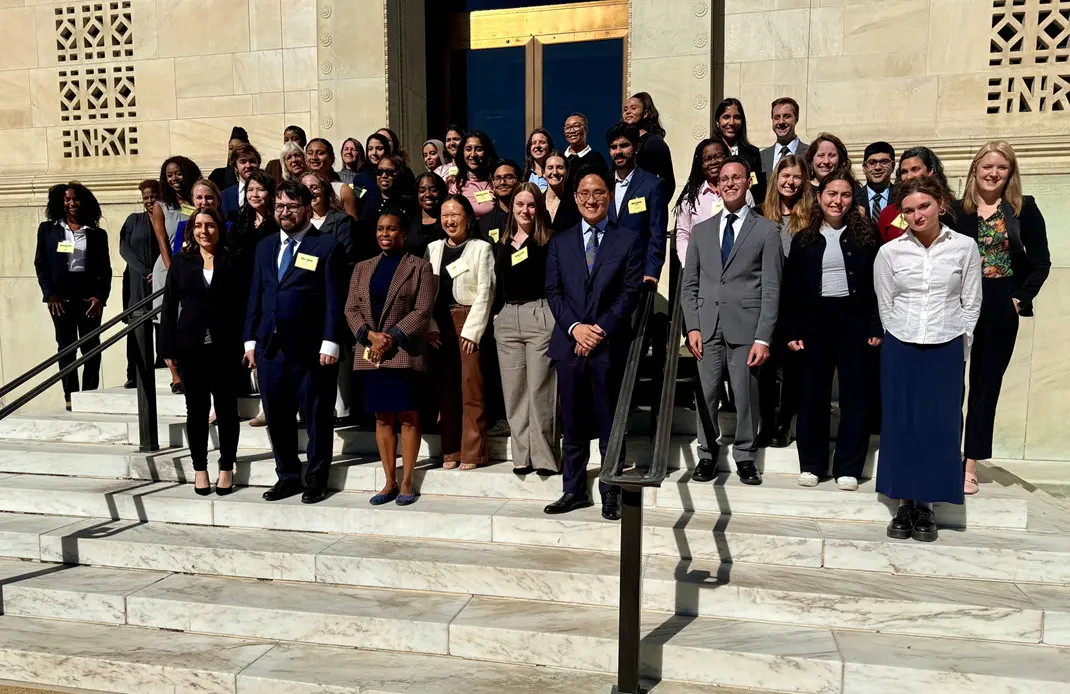
 The winners of the 12th annual DC Public Health Case Challenge were announced on Friday, October 17, 2025. This year’s challenge topic was “Strengthening Health Resilience for Chronic Disease in the District of Columbia Through Technology and Data Solutions.” Chronic conditions such as cardiovascular disease, diabetes, and asthma remain leading causes of illness and death in the District of Columbia, with rates that vary widely across the city’s eight wards. Environmental factors — including extreme heat, poor air quality, and limited access to green space — compound these risks and disproportionately affect some DC communities, presenting opportunities to use data and digital tools to anticipate risks, improve coordination of care, and strengthen community health resilience.
The competing teams were invited to design equitable, technology-enabled approaches — grounded in community needs and responsible data use — that help residents prevent, prepare for, and adapt to evolving risks related to chronic disease in DC.
Teams from DC-area universities—each with up to six members from at least three disciplines—had just two weeks to develop innovative, feasible solutions with a hypothetical $1.5 million budget to be used during a three-year span. Proposals were evaluated by a panel of expert judges for interdisciplinarity, feasibility, creativity, equity considerations, and practicality. Examples included leveraging environmental and clinical data to anticipate risks (e.g., air quality, food insecurity), using digital tools for early warning and outreach, and providing high-quality information to inform better service provision in the public sector and better legal recourse for addressing environmental risk factors — with attention to privacy, interoperability, and accessibility.
The 2025 Grand Prize winner was the team from the Uniformed Services University, which included Rayomand Kapadia, Michael Lindow, Needhi Sharma, Sabrina Torres, and Yoland Victor, with faculty adviser Bolanle Olapeju. Their solution, titled FreshLink DC, proposed leveraging health and geospatial data to create a bicycle-based mobile market for wholesale produce, implemented in partnership with local community organizations to address food insecurity and reduce risks of obesity, hypertension, and diabetes.
Three additional prizes were awarded:
The Harrison C. Spencer Memorial Interprofessional Prize was awarded to the team from Georgetown University for Breathe Easy, an intervention to mitigate mold as a key cause of respiratory illness in schools and assisted living residences for older adults through indoor and outdoor air quality sensors, HEPA filter installation, and green buffers such as trees. Team members were Omar Anwar, Talia Korobkin, Harnoor Sachar, and Shivali Vora, and their faculty advisers were Leticia Bode and Sophie Zou.
The Practicality Prize was awarded to the team from Howard University for their proposed solution titled H.O.M.E. DC (Healthy Occupancy & Mold Eradication). Their solution focused on housing neglect that contributes to pediatric asthma exacerbation and included a fully developed prototype for an app to document, report, and inform enforcement action related to residential mold exposure. Team members were Savannah Bullard, Dakota Douglas, Tanganikka Franks, Bipul Gyawali, Kira McHugh, Quai Skeete-Ridley, and their faculty advisers were Pamela Carter-Nolan, Briana Jeffreys, and Monica Ponder.
One Wildcard Prize for a multi-solver solution (i.e., working on multiple levels to shift contributing factors) went to the University of Maryland, Baltimore team for SPROUT (School Partnership Reducing Obesity Using Technology), an elementary school intervention to improve nutrition and access to fresh produce that consisted of a school-based greenhouse and a related app. Team members were Nikki Akparewa, Raina Crew, Tina Garcia, Jake Kim, Elliott Klein, and Hannah Lowe, and their faculty advisers were Greg Carey and Rebecca Hall.
The 2025 Case Challenge judges were:
- David Bychkov, research consultant, University of California Institute for Prediction Technology
- Elham Hatef, associate professor, Division of General Internal Medicine, Johns Hopkins School of Medicine; core faculty, Center for Population Health IT, Department of Health Policy and Management, Johns Hopkins Bloomberg School of Public Health
- Brooke Hatfield, senior director, Health Care Services in Speech-Language Pathology, American Speech-Language-Hearing Association
- Bobby Milstein, director of system strategy, ReThink Health and the Rippel Foundation; visiting scientist, MIT Sloan School of Management
- Surili Sutaria Patel, Health Equity Advocate & Public Health Consultant with Boundless Workshop, LLC
- Scott Wollek, director, Maryland Hospital Preparedness Program, Maryland Hospital Association
The DC Public Health Case Challenge, launched in 2013, aims to promote interdisciplinary, problem-based learning around a public health issue of importance to the Washington, D.C., community. The challenge is co-sponsored by the National Academy of Medicine’s Kellogg Health of the Public Fund and the National Academies of Sciences, Engineering, and Medicine’s Roundtable on Population Health Improvement, with additional support from the Global Forum on Innovation in Health Professional Education.
The National Academy of Medicine (NAM), established in 1970 as the Institute of Medicine, is an independent organization of eminent professionals from diverse fields including health and medicine; the natural, social, and behavioral sciences; and beyond. It serves alongside the National Academy of Sciences and the National Academy of Engineering as an adviser to the nation and the international community. Through its domestic and global initiatives, the NAM works to address critical issues in health, medicine, and related policy and inspire positive action across sectors. The NAM collaborates closely with its peer academies and other divisions within the National Academies of Sciences, Engineering, and Medicine.