By Karen Meurer Bacellar
NAM Emerging Leader in Health and Medicine Raman Bahal is exploring new frontiers in precision medicine at UConn, where his laboratory is developing ways to deliver treatments to specific cells while limiting damage to healthy tissue.
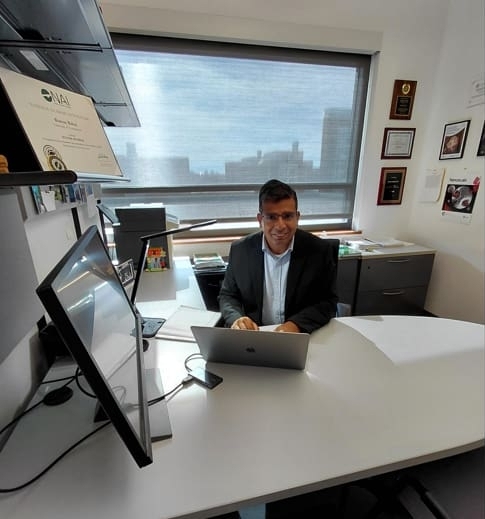
Raman Bahal in his lab office.
Among the various instruments that line the workstations in Raman Bahal’s laboratory sits an unassuming box of cards, each carrying a message from family and friends of children impacted by cancer. The cards came from families connected to the foundation that helped fund Bahal’s research when he established his lab at the University of Connecticut in 2017. When I visited in September, he opened the box to share some of these messages. He keeps them in the lab, he explained, as a reminder to his students of the people their work could someday help.
Much of that work aims to fundamental challenge in drug development: knowing how to design a treatment that acts on a disease does not mean knowing how to get it to the cells that need it.
Bahal, a professor of pharmaceutics at the University of Connecticut School of Pharmacy and Pharmaceutical Sciences, was selected for the Victor J. Dzau Emerging Leaders in Health and Medicine program at the National Academy of Medicine (NAM) in 2025.
Researchers in Bahal’s laboratory design synthetic molecules that bind to specific DNA or RNA sequences and examine how they can disrupt or regulate these genetic instructions. The goal is to develop treatments that modify key processes involved the development of genetic diseases and cancer. Some of their work targets messenger RNA (mRNA), a single-stranded genetic molecule that carries a gene’s instructions for making a protein, and microRNAs (miRNA), which help regulate the process of protein production. Other projects focus on DNA itself, primarily investigating ways to prevent select genetic instructions from being read.
Alongside these efforts, the lab develops novel therapeutic delivery systems, including tiny carriers and chemical guides. Reaching an organ is not enough; a given drug must be able to enter the appropriate cells and get to the place inside them where it can act. According to Bahal, that kind of precision can limit harm to healthy tissue in addition to being more efficient overall.
“You don’t want to fix one process and mess up with the other,” he emphasized.
Learning to look beyond the experiment
Although a career in research and drug development wasn’t originally on his radar, Bahal had been drawn to science since childhood. Growing up in a small town in Punjab, India, he knew that students interested in science typically followed 1 of 2 paths: medicine or engineering. Still, his curiosity had a way of reaching beyond those familiar options. By ninth grade, he was reading his older sister’s chemistry textbooks, seeking out scientific material well beyond what he was learning in school. His interest eventually led him to a scholarship-supported master’s program at the National Institute of Pharmaceutical Education and Research (NIPER) in Mohali. With his father as the family’s sole earner, the scholarship helped ease the financial burden of his education. It was there that Bahal began to see research as a possible career. Encouraged by his sister, who also became a chemist, he considered doctoral programs abroad and ultimately joined chemist Danith Ly’s laboratory at Carnegie Mellon University.
When Bahal brought Ly a research proposal, his adviser pressed him on what he would do if an experiment failed. What would he try next? Where did he ultimately want the work to lead? Bahal began to appreciate the thinking that went into those decisions, and by the third year of his doctorate, he had decided to pursue an academic career.
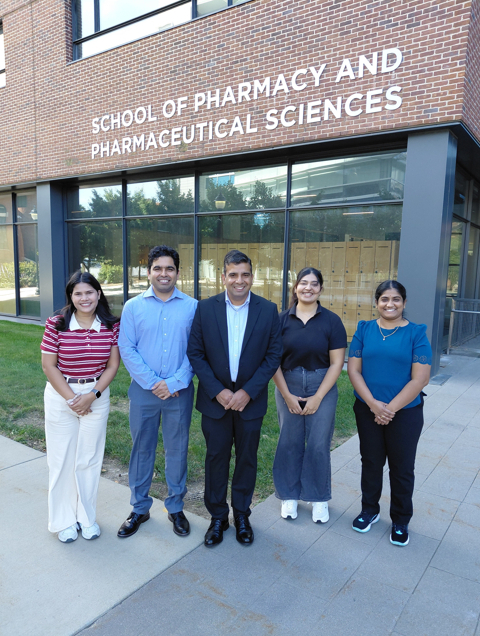
Members of Bahal’s laboratory (from left to right): Ruchi, Dr. Vikas Kumar, Dr. Raman Bahal. Hamayal Sharma, Mounika Pathuri
Learning molecular biology alongside chemistry also made him curious about what happens to a molecule once it leaves the chemist’s bench and enters a living organism. During his postdoctoral training in Peter Glazer’s laboratory at Yale, he began attending lab meetings with Glazer’s collaborator, biomedical engineer W. Mark Saltzman., Although he formally belonged to only one laboratory, he was encouraged to learn from both. Bahal soon began presenting his work to both groups, learning about drug delivery and discussing projects with both mentors.
Given his own career path, it is fitting that a cross-disciplinary approach is central to Bahal’s research philosophy. He encourages students to look beyond their own specialties and understand each stage of a project, helping them identify unanswered questions and recognize when to draw on expertise from other fields.
His role at NAM offers opportunities for further interdisciplinary exchanges, this time with professionals whose work includes clinical care, population health, and health policy. He serves a three-year term among the Victor J. Dzau Emerging Leaders in Health and Medicine (ELHM) Scholars, who participate in NAM activities and connect with its members and other scholars.
How Small Chemical Shifts Can Change a Molecule’s Course
In his own laboratory, Bahal began exploring a question that required both kinds of knowledge. Scientists had found ways to guide nucleic acid medicines to liver cells using carbohydrate molecules. He wondered if other carbohydrates could be leveraged to achieve similar outcomes.
Enter lactobionic acid, a carbohydrate that Bahal’s team had shown could help direct molecules to the liver. When they changed parts of its chemical structure, the modified carbohydrate molecules showed a preference for the kidneys instead.
“These results were especially compelling given the kidney’s vital role: it led me to wonder what was going on here,” Bahal recalled.
Small chemical changes had altered where the molecules went. Understanding why meant looking more closely at the cells they entered.
Carbohydrates can act as ligands, a molecule that binds to a receptor on a cell’s surface.
Some receptors will draw the carbohydrates into the cell itself. By chemically attaching a medicine to a specific carbohydrate, which Bahal refers to as a “molecular zip code,” researchers can accordingly use this mechanism to help carry the treatment into the cell. However, because the same receptor may be present on multiple cell types, identifying a molecule that binds to a receptor does not necessarily predict where the attached medicine will go. Working with Yale Stefan Somlo, Bahal’s team investigated the behavior of chemically-modified lactobionic acid in mice. Their work produced a novel delivery system called RENTAC, short for renal tubule-targeting carbohydrate. In a 2024 study, published in Molecular Therapy, the researchers showed that attached molecules reached cells in kidney structures called proximal tubules and remained in the kidneys for several days.
They also used RENTAC to carry an experimental molecule designed to block a miRNA involved in kidney scarring. Treated mice developed less scar tissue after experiencing chemically-induced kidney injury. Treatment began before the injury, however, so the findings do not establish that the approach reverses existing scarring. Nor do these animal studies establish safety or effectiveness in people.
Bahal co-founded Zeal Therapeutics to further pursue development of this kidney-targeted delivery technology. That next step brings a whole new set of questions, including whether molecules made in small amounts can be manufactured at a larger scale without compromising their stability.
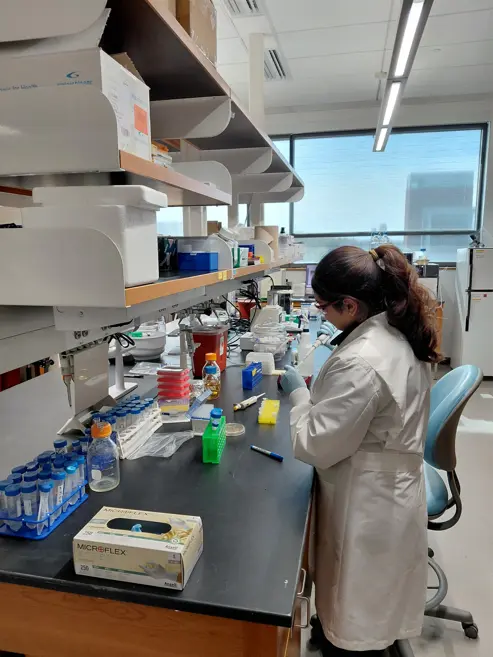
Graduate student Hamayal Sharma is hard at work in the lab.
Back in the laboratory, those questions take shape through a series of experiments designed to reveal how the molecules behave and whether they work as intended.
During my September visit, doctoral student Sai Pallavi Pradeep, explained how comparing treated and untreated cells helps reveal whether a potential treatment changes a gene’s activity. The team extracts RNA and measures how much of a particular mRNA molecule is present; this provides one measure of the treatment’s effect. The researchers then must investigate what that change means for the cell.
Other tests help assess safety, including screening animal blood samples for potential signs of harm. Researchers also demonstrated how they separate newly made compounds before testing to ensure they can identify each individual molecule.
For doctoral student Mounika Pathuri, who trained in pharmaceutical science, this work represents the future of drug development.
“Individualized health care is finally starting to become a reality,” she said.
Delivering on the Promise of Precision Medicine
In an accompanying NAM Perspectives discussion paper, Using AI and Machine Learning to Advance Nucleic Acid Therapeutic Delivery Beyond the Liver, Bahal and colleagues consider how researchers could make the search for new delivery routes like RENTAC more systematic. The authors include two members of his lab, assistant research professor Vikas Kumar and doctoral student Sai Pallavi Pradeep, along with Saltzman and UConn toxicologist José E. Manautou.
The development of RENTAC offers a case study in both the promise and complexity of this search. A chemical change can alter where a molecule goes, but researchers cannot readily predict which changes will prove useful. Artificial intelligence and machine learning could help them select more promising candidates before making and testing them.
For example, computational models could suggest which chemical structures are likely to bind to a receptor. Information about where that receptor occurs in the body could then help researchers assess whether the interaction might direct a medicine toward the intended cells or send it elsewhere.
Live experiments would still be essential to the development process, Bahal and his coauthors assured. A cell can take in a potential medicine but trap it in an internal compartment, preventing it from reaching the genetic information it is supposed to act on. Disease can also change the receptors a cell carries, making predictions based on healthy tissue unreliable. The authors propose using experimental results to improve the models, so subsequent predictions better reflect what happens in living systems.
Those delivery challenges also shape his cancer research, the work that brought those families’ cards into the lab. For the DNA-targeting treatments his team is investigating, reaching the right organ would be only the beginning. The molecules must enter the intended cells, reach the nucleus, and bind to a specific part of the DNA.
His team uses peptide nucleic acids, or PNAs, synthetic molecules designed to recognize matching sequences in DNA or RNA. They bind to genetic material much as natural DNA and RNA strands pair, but their different chemical structure makes them harder for enzymes to break down.
The goal is to prevent selected genetic instructions from being carried out without affecting the DNA code. Blocking transcription, the process of copying those instructions into mRNA, could reduce the production of a protein involved in tumor growth.
In a 2026 study published in Precision Oncology, the researchers targeted the VEGFA gene, which encodes a protein involved in blood-vessel growth and tumor development. Their approach slowed tumor growth in a mouse model of triple-negative breast cancer.
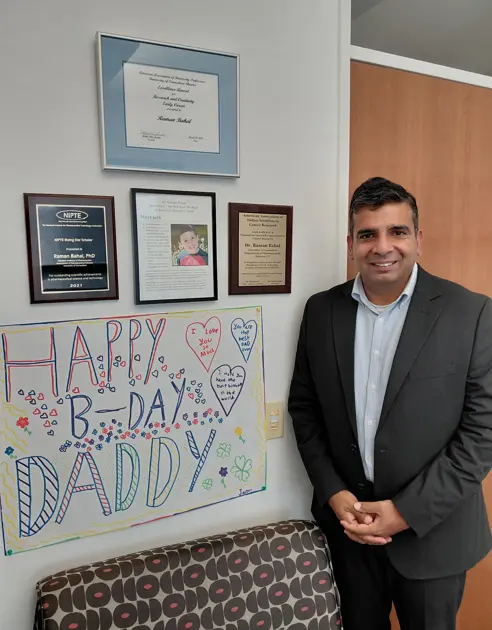
Bahal poses in front of several plaques and a hand-drawn poster reading “Happy B-Day Daddy”hung up in his office.
Centering the People Behind the Science
For Bahal, the larger goal is to move beyond simply controlling or curing disease and reduce the physical toll of care. Chemotherapy, for example, can be used to manage or even cure cancer, but it can also harm healthy cells that divide rapidly, including those in the digestive tract and hair follicles. That damage can contribute to negative side effects like nausea, mouth sores, and hair loss. More precise drug delivery could help limit that collateral damage, allowing patients to experience fewer or less severe side effects during treatment,
Bahal envisions treatment given by injection or infusion that could travel to the affected organ, enter the cancer cells, and interfere with the processes sustaining the tumor while limiting damage to healthy tissue. Making that possible would require both the delivery system and the treatment itself to work as intended. A molecule that recognizes a genetic target cannot help a patient if it never reaches that target; one that reaches a tumor still needs to act effectively once inside its cells.
This vision remains a work in progress. Further research is needed to determine whether the approach can safely and effectively treat cancer without causing cells to become treatment resistant. Still, Bahal says that the oncologists he speaks with all ultimately agree that, even without a cure, controlling disease while helping patients feel better during treatment would be meaningful progress.
“If you can … improve the quality of a patient’s life, that’s a big success,” he said.
For Bahal, the complexities of research and drug development should never overshadow the reason for pursuing them in the first place: improving patients’ lives. In his office, photographs of his own family sit alongside a picture of a young patient connected to the foundation that supported his early cancer research. Alongside the cards that he displays for his students, these photographs serve as tangible reminders of the people at the heart of his work.
“It truly motivates us to keep going,” Bahal said. “Research is demanding work that requires substantial time and careful consideration. Nevertheless, the team’s efforts are essential to developing new medications that may ultimately benefit patients and their families.”
Read more about Dr. Bahal’s work in the following publication: Using AI and Machine Learning to Advance Nucleic Acid Therapeutic Delivery Beyond the Liver.