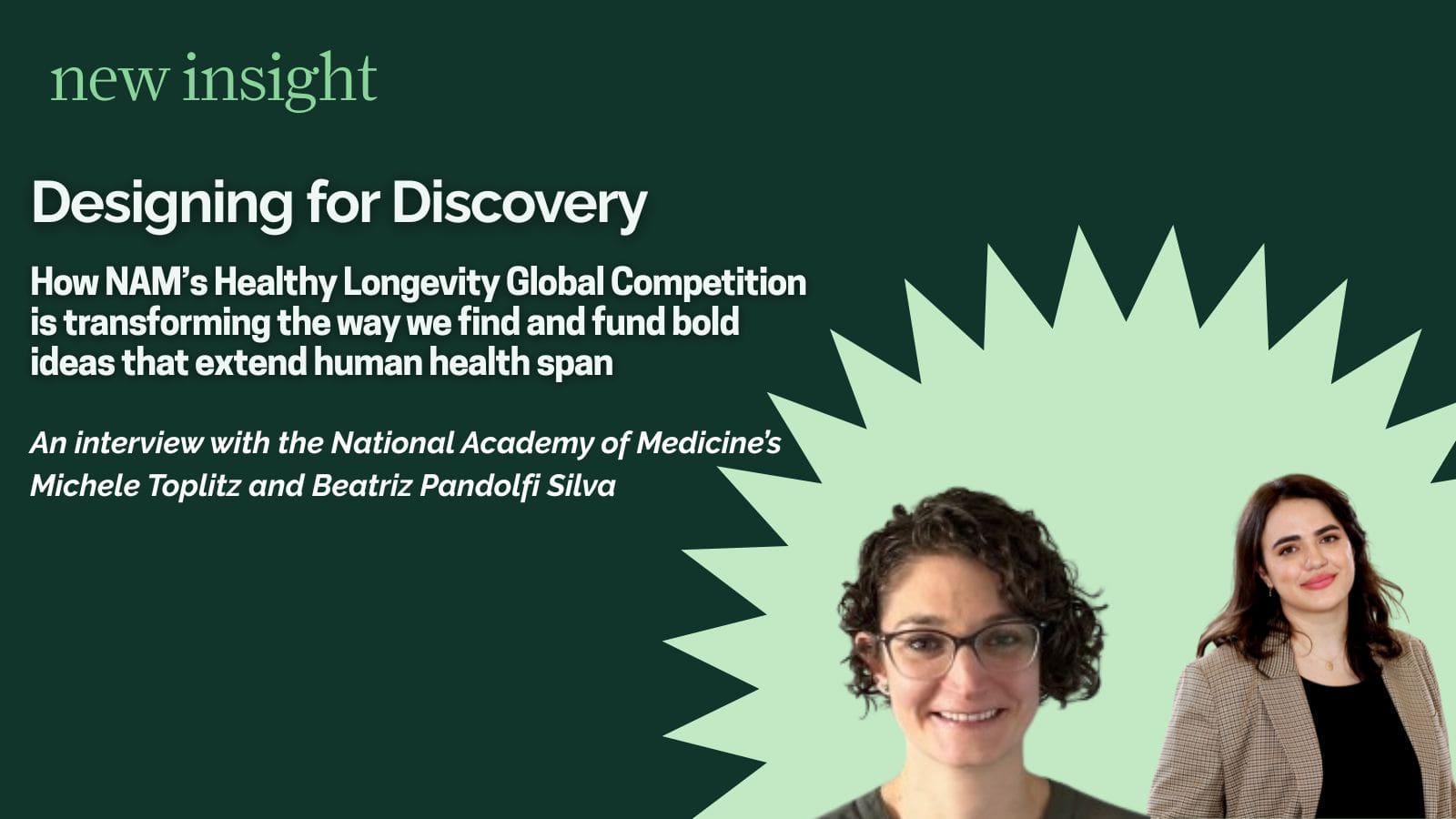
Since 2020, the National Academy of Medicine’s Healthy Longevity Global Competition has supported more than 600 actionable ideas aimed at extending the human health span and improving quality of life. Many have come from early career researchers and innovators working in adjacent fields—people who might not have advanced through a traditional grant process that often requires extensive preliminary data and demonstrated institutional capacity. By removing those barriers and prioritizing bold, early-stage ideas with transformative potential, the competition has surfaced work that may have otherwise gone unseen.
Michele Toplitz and Beatriz Pandolfi Silva lead the strategy and day-to-day implementation of the competition. In this interview, they reflect on what made this competition model so different when it launched, how it has evolved over six years and across global contexts, and what they’ve learned about running a competition that is both rigorous and radically accessible.
The following interview has been edited for length and clarity.
The Healthy Longevity Global Competition was described as pioneering when it launched. What gaps in the field or ecosystem were you trying to address at the time?
Toplitz: The competition is one part of the Healthy Longevity Global Grand Challenge, which officially launched in 2019 and was the National Academy of Medicine’s first Grand Challenge. The challenge includes a three-phase competition: the Catalyst Awards, which provide $50,000 in seed funding for bold, early-stage ideas; an Accelerator phase for projects that demonstrate progress and strong potential; and a Grand Prize, to be awarded in 2026, that will recognize the most impactful innovation—or innovation with the greatest potential for impact—to emerge from the global cohort.
We launched the first Catalyst Awards in 2020, but the effort began in 2016 when NAM members voted to prioritize healthy longevity as the focus of a Grand Challenge. They recognized global population aging as a defining challenge of the 21st century and a prime arena for innovation and impact.
There have been dramatic advances in medicine, public health, and economic development that extended human lifespan in unprecedented ways, but the human health span (or number of years people remain in good health) has not shown comparable progress. Through the competition and the Global Roadmap for Healthy Longevity consensus study, the NAM set out to help catalyze the therapies, technologies, and systems that would allow people to live healthier, more functional lives as they age.
The gap we set out to fill was clear: when this work began, bold, innovative ideas received little support, especially those without preliminary data or that did not fit existing funding structures. The competition was designed to close that gap by accelerating research, innovation, and entrepreneurship in the multidisciplinary field of healthy longevity.
You’ve both emphasized that the competition model is as much about process as it is about outcomes. What makes this model distinct from more traditional grantmaking or research competitions?
Pandolfi Silva: The structure draws inspiration from several established competitions but perhaps with a sharper focus on innovation. The Catalyst Award is a $50,000 seed prize designed to fund bold ideas at an early stage. The application is intentionally short—just two pages—and we don’t require preliminary data. You don’t need to come from a specific institution, and your field doesn’t need to be specific to or focused on aging. It could be basic science, health tech, social science—anything, as long as the idea can be applied to promote healthy longevity. We wanted to create something accessible that would bring in new voices and allow people to apply their expertise to this space, even if they hadn’t worked in it before.
Toplitz: Yes, and I think that low barrier to entry has been a really important part of the model. It opens the door for early-career researchers who might not have a long track record or those without traditional academic credentials. We’re not looking at publication history. We’re not asking for institutional endorsement. We’re evaluating the boldness and potential of the idea itself.
Another key distinction is that the award is a prize for an innovative idea, not a traditional grant. It is intended to go directly to the innovator or research team, and we don’t require a budget breakdown. That flexibility is intentional. It allows people to use the funds in whatever way is most helpful— whether that means hiring a research assistant, attending a conference, buying equipment, and so on. The model is built to encourage unconventional ideas with the potential to spark real transformation.
Over nearly a decade, the competition has supported hundreds of ideas worldwide. How has the structure or philosophy of the competition evolved as the field has matured?
Toplitz: The original plan was to run the Catalyst Awards for three years, but the response from our global partners was so strong that we extended it to six. They saw the value in a model that provided seed funding for innovative projects, and we wanted to give even more teams the chance to advance their ideas.
That shift is what has allowed us to fund a broader range of projects. In some cases, getting a Catalyst Award helped teams build enough momentum to attract additional and more substantive funding elsewhere. That ripple effect was something we hoped for from the beginning.
We also evolved the review process. After the first year, we brought in venture capitalists to be part of the innovation review alongside academics and research scientists. Their entrepreneurial perspective has been a real asset, especially when evaluating early-stage ideas that may be untested but have the potential for significant impact.
Pandolfi Silva: Now we have a layered review process. The initial phase focuses on innovation. For the US-based Catalyst Awards that NAM administers directly, we ask three reviewers to assess each application on dimensions of innovation, potential for impact, quality, and scope. That review informs selection of approximately 40 finalists, after which we engage subject matter and venture capital reviewers to provide additional depth and perspective, ensuring a more comprehensive and well-rounded evaluation. All of that information is passed on to our selection committee, the group that ultimately determines which applicants receive the awards. It’s all still based on a two-page application. That part hasn’t changed.
Many of the most impactful innovations in healthy longevity have come from adjacent or unexpected disciplines. How does your process intentionally invite or support that kind of cross-sector thinking?
Toplitz: From the beginning, one of our goals was to broaden who thinks of themselves as working in the healthy longevity space. We weren’t just looking for researchers focused on aging—we wanted to reach people in fields that could be applied to health across the lifespan, even if they didn’t see their work as longevity-related. That’s why we’ve always emphasized that the Catalyst Awards are open to any discipline, as long as the idea has relevance to healthy longevity.
To support that, we’ve promoted the competition well beyond NAM’s traditional networks. Each year we’ve done more extensive and targeted outreach—on LinkedIn, for example—to connect with early-career professionals, technologists, and innovators across fields. And we’ve intentionally diversified our pool of reviewers to include people from a wide range of sectors, not just academia. That helps ensure diversity of perspective in evaluating the ideas.
Pandolfi Silva: We also create opportunities for awardees from across disciplines to connect with one another. Our annual Global Healthy Longevity Innovator Summit brings together Catalyst winners from every year of the competition. It’s virtual, so it’s accessible, and we design the panels to cut across disciplines, sectors, and geographies. We also set up a LinkedIn group for awardees so they can share resources, connect, and even find collaborators. It takes work to build that kind of community, but it’s been one of the most rewarding parts of the program.
You’ve worked closely with international partners to replicate the Catalyst Award model in different contexts. What lessons have you learned about adapting the process across cultures, funding structures, and health systems?
Toplitz: Our partners have implemented their own version of the Catalyst Awards—specifically, the $50,000 seed prize and the brief application with a focus on innovation. But one of the biggest lessons has been the importance of flexibility. While all our collaborators work from the same core framework, each one has had to adapt it slightly to fit their local and institutional context.
For example, our partner the Regional Grants Council of the Hong Kong Special Administrative Region, China administers the competition through the public university system, which means applicants must be affiliated with one of eight universities. That’s different from the open-call approach we use in the United States, but it works within their infrastructure. Similarly, some partners fund their awards through existing grant mechanisms rather than prize structures, depending on what is permissible; the NAM’s global partners include government agencies, medical academies, and other types of entities that have their own respective requirements.
Pandolfi Silva: And those kinds of adaptations are totally expected. We’re not prescribing a one-size-fits-all model. What we care about is maintaining the spirit of the competition—keeping the application accessible, prioritizing innovation, and bringing in new and multidisciplinary teams and voices. As long as those principles are intact, we encourage our partners to shape the process in ways that make sense for them. That flexibility has been key to the program’s success and sustainability across such a wide range of countries and institutions.
What advice would you give to someone looking to launch a similarly ambitious, interdisciplinary initiative in a fast-evolving field?
Toplitz: One of the biggest lessons is the value of strategic communication. You need a clear plan for how to reach different audiences—especially if you’re trying to share the funding opportunity and solicit applications from outside your traditional networks.
Another piece of advice: if you’re working with multiple partners, build in a shared and uniform approach to data collection from the start. Identify the desired outcomes and big picture impacts of the initiative and establish processes to collect information that allows for monitoring progress towards those outcomes.
Also, think about how you’re going to foster connection across your community. Especially in interdisciplinary, global efforts, it’s not just about funding great ideas—it’s also about helping those innovators learn from and inspire one another.
Pandolfi Silva: I’d add that it takes persistence to reach across disciplines and sectors. You have to be intentional about who you invite to review, how you promote the opportunity, and what signals you send about who is encouraged to apply. It’s not a quick process, but it makes the whole initiative stronger.
What insights have surprised you the most through your work with the innovators in this space?
Toplitz: One thing that became clearer over time is just how broadly the concept of healthy longevity can be applied. We have honed our messaging over the years, conveying that healthy longevity is really about health across the entire lifespan. We have tried to encourage submissions focused on any stage of life (e.g., early childhood, middle age, older adulthood)—provided that they establish a connection to health as we age. As we know, health in earlier phases of life can shapes outcomes later on.
We were also pleasantly surprised by the range of disciplines that have found a way into this work. We’ve seen proposals in digital technology, behavioral science, public health, architecture, and even design. The creativity and cross-sector thinking have been incredible. It’s made us more expansive in how we talk about the field and who we see as part of it.
Pandolfi Silva: It has been exciting to see just how many people from such varied backgrounds had powerful ideas about aging and health. I didn’t come into this work as a longevity expert myself, so it’s been a great surprise to see how open and interdisciplinary the space really is. That’s what makes the Catalyst model so special—it gives those people a way in.