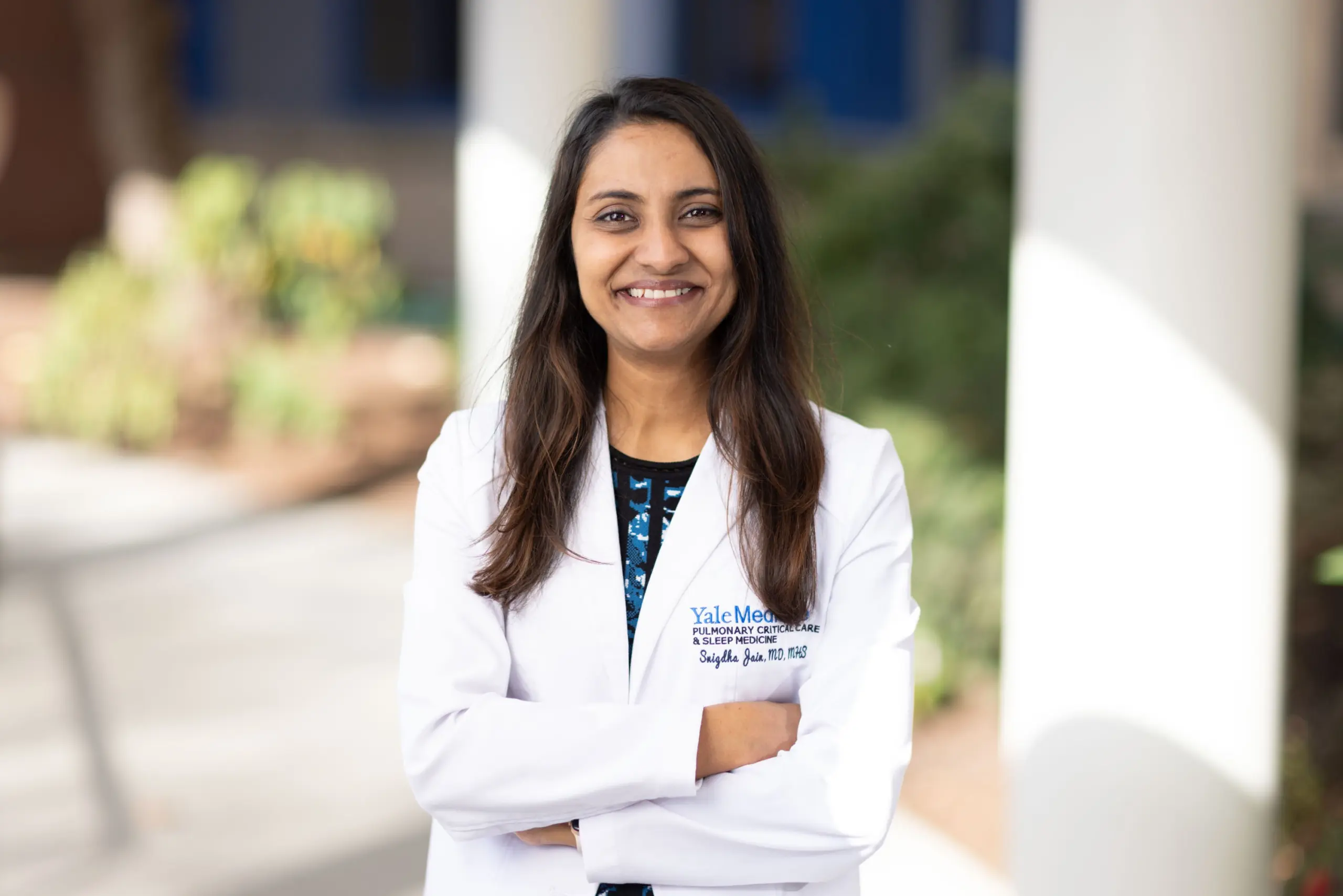
Snigdha Jain is an assistant professor and pulmonary and critical care physician at Yale School of Medicine. Photo courtesy Snigdha Jain
For Dr. Snigdha Jain, diagnostic excellence is an ongoing practice of reassessment. Through the National Academy of Medicine Scholars in Diagnostic Excellence program in partnership with the Council of Medical Specialty Societies, she is turning a bedside question into a broader effort to improve care for older adults.
By Karen Meurer Bacellar
On day two of Ms. S’s ICU stay, her care team had a treatment plan in place.
Ms. S, a 70-yr old woman, had chronic obstructive lung disease. She had arrived short of breath and was diagnosed with pneumonia. She was intubated and placed on a ventilator to help her breathe.
The next morning on rounds, residents and fellows moved briskly through the standard checklist. Antibiotics. Cultures. Viral panels. The flu test came back positive. Steroids, a standard treatment for severe pneumonia, were administered. Everything was in motion, and everything sounded right.
Then Snigdha Jain, an assistant professor and pulmonary and critical care physician at Yale School of Medicine, asked a different question.
“All of this is great,” she told the team. “But how are we getting her off the ventilator?”
For the junior trainees, it was not the question they expected. They looked at her as if to say, “That’s not what we were talking about.”
It was the question Jain wanted on the table.
In the ICU, Jain has learned that momentum is powerful. Once a patient is on the ventilator, once a diagnosis feels settled, it’s easy for care to become focused on what can be added. One more medication. One more test. One more day, just to be safe. And sometimes that instinct is lifesaving.
But sometimes, Jain says, the most important work is the opposite: to pause, reassess, and take something away.
“Getting your patient off the ventilator is key for their recovery,” Jain said.
That mindset sits at the heart of how Jain thinks about diagnostic excellence. It also helps explain why she sought out the National Academy of Medicine (NAM) Scholars in Diagnostic Excellence program at a very specific moment in her career, as she builds an independent research program focused on improving how older adults recover after critical illness.
She brought the question. The Scholars in Diagnostic Excellence program has given her a platform, a language, and a network to scale it.
A Calling Shaped by Service
Jain’s path to medicine started long before she had language for “diagnostic excellence” or a research agenda. She was born and raised in India, where both of her parents rose from humble beginnings to become physicians and built careers rooted in service.
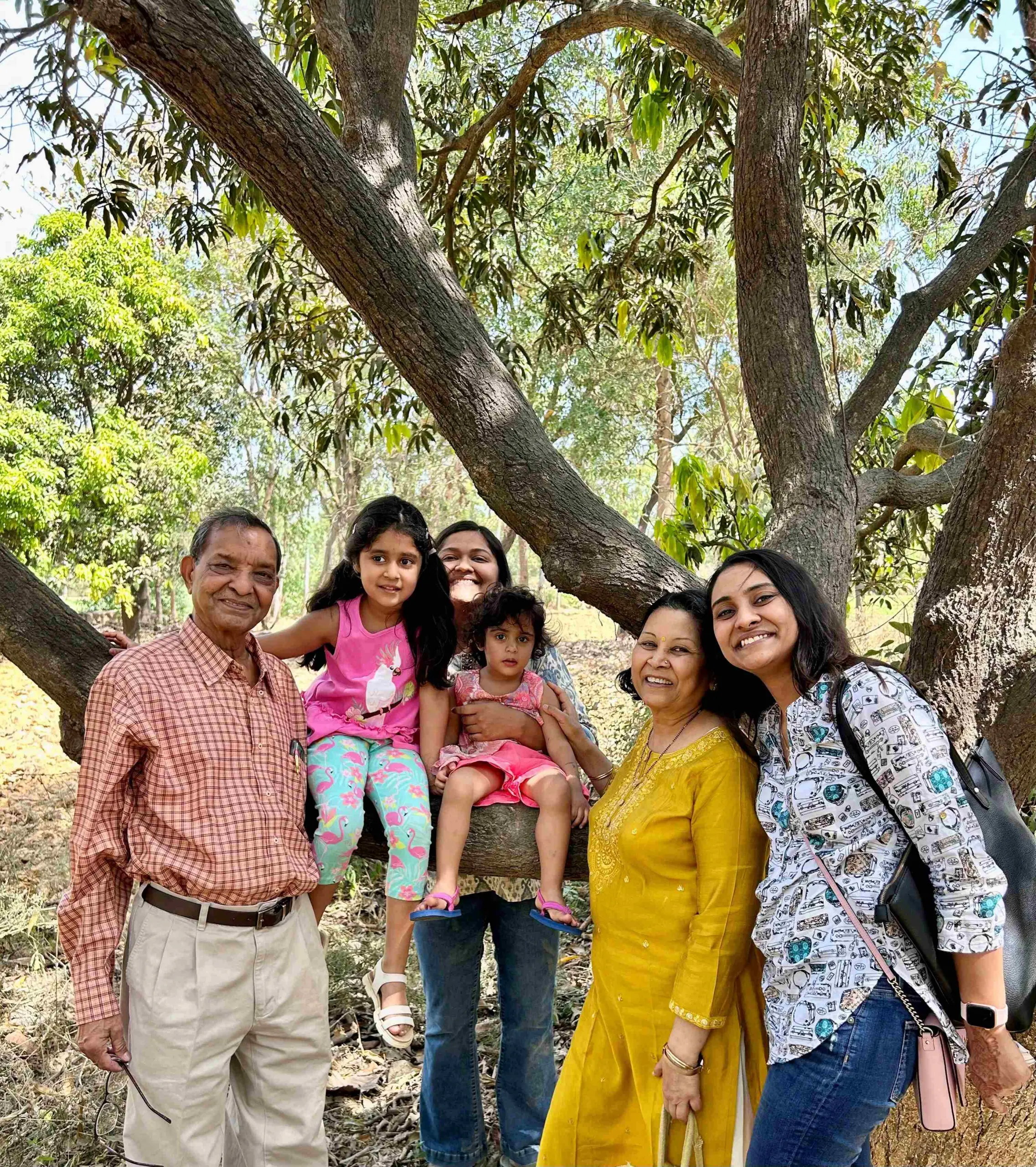
Jain (far right) and her family visit their mango orchard in her father’s ancestral village. Photo courtesy Snigdha Jain
As a young child, she watched her father bring modern diagnostic tools to their small town, including the first CT scanner and the first MRI machine. She watched her mother provide obstetric care, essentially around the clock, to women in their community.
“Medicine for me was always a calling that was rooted in responsibility and a sense of giving back to your community,” Jain said.
Research came later. In medical school, as she cared for patients on clinical rotations, she noticed differences in outcomes that could not be explained by clinician effort alone. She was struck by how a patient’s individual needs, environments, and care processes interacted in complex ways and how those interactions shaped who recovered and who did not.
“I became curious around the why of that,” she said. “Research offered a way to understand those patterns, to think about solutions, and improve care.”
She also understood early that if she wanted to pursue that work, she would need training and opportunities beyond what was common for many medical students in India at the time. She ultimately came to the United States for further training, building a career that would combine bedside critical care with clinical epidemiology and implementation science.
The Problem That Does Not End at Discharge
In critical care medicine, success is often measured in absolute terms: Did the patient survive? Did they come off the ventilator? Did they leave the ICU?
Over time, Jain started paying closer attention to what came next, particularly for older adults.
She saw patients who survived critical illness and left the hospital but returned weeks later profoundly changed: weaker, with new disabilities, with lingering cognitive impairment, or with anxiety and depression that had not been there before. The ICU saved their lives, but the experience could leave lasting scars.
This is where her definition of diagnostic excellence widened.
For Jain, diagnosis is not only the moment a label or treatment plan is first assigned. It is an ongoing discipline of re-evaluation: checking assumptions, resisting anchoring, and asking whether the current plan still fits the patient’s physiology and the patient’s goals.
She sees “over-treatment” as part of the diagnostic problem. When teams get locked into a course of action, the system’s momentum can make it harder to recognize when the diagnosis has shifted, when the condition is improving, or when continuing aggressive therapy no longer makes sense.
In the case of the ICU patient on a ventilator, the question was not whether the patient had pneumonia. The question was how quickly, safely, and thoughtfully the team could return to breathing on her own.
Jain’s intervention was practical. She asked the team to pause sedation for a few hours so they could see how the patient progressed while awake on the ventilator, and whether she could tolerate a path toward breathing on her own. When the sedation was held, the patient gradually woke up and appeared comfortable. The team then ran a spontaneous breathing trial, and she passed it: a sign she was close to ready. She still needed a few things optimized, including getting some excess fluid off, so they did not extubate her that same day. But the next day, the team was able to remove the breathing tube, and she moved out of the ICU soon after.
The lesson Jain wanted trainees to absorb was simple: excellent care is not only what we add. It is also when we have the judgment to stop.
Why the Scholars in Diagnostic Excellence Program, and Why Now
By the time Jain learned about the Scholars in Diagnostic Excellence program, she already had a clear line of sight on the problems she wanted to tackle. What she needed was a way to push those ideas further, to test them rigorously, and to translate them into work that could spread beyond a single unit or a single institution.
She first heard about the program through a colleague who described how it offered a national community for people working on diagnosis, plus mentorship and practical support to refine projects and accelerate impact. For Jain, the fit was immediate.
“I really wanted to connect with a community of like-minded clinicians and researchers who care about diagnostic excellence,” she said, “and can serve as sounding boards and stress testers for my own ideas.”
Jain also wanted to broaden her view beyond the ICU. Diagnostic excellence looks different in primary care, emergency medicine, pediatrics, and specialty clinics. Learning how leaders in those settings define and measure diagnosis, and how they design interventions, could shape how she approached ICU decision support.
Now halfway into the program, she says the promise has been real.
Connecting with an NAM mentor has been “incredibly useful,” she said. Her mentor, Dr. Scott Halpern, provided useful feedback on her project and connected her with an implementation science advisor who helped her with a grant proposal. National leaders in diagnostic excellence she met through the program, like Dr. Hardeep Singh, have inspired new ideas and facilitated collaborations to scale her project. Her cohort built community quickly, including a large WhatsApp group where scholars share updates and celebrate wins. At the NAM meetings, they have met outside formal programming, turning a fellowship experience into real relationships.
“It’s an exceptionally supportive, encouraging group of people who are all doing impressive, innovative work in their areas,” Jain said.
She also points to the program’s leadership support. “Helen Burstin is just such a force,” Jain said. “Whenever I mention someone that I’d like to connect with, she always offers thoughtful guidance and makes those introductions.”
For a busy early-career physician-scientist, that kind of connective tissue matters. It turns professional isolation into momentum of a different kind.
A Moment That Changed How She Teaches Uncertainty
When Jain talks about the program’s impact so far, she does not point to a single defining epiphany. Instead, she describes a series of conversations that make diagnostic excellence feel more practical and more central to everyday medicine.
One exchange, in particular, captures what she has valued most.
In a monthly virtual session with national leaders Gurpreet Dhaliwal and Kimberly Manning, the focus was uncertainty: how to embrace it, how to articulate it, and how to lead teams through it without pretending it is not there.
The conversation resonated with Jain because uncertainty is the atmosphere of critical care. The ICU is full of incomplete information, shifting physiology, competing risks, and time pressure. It is a setting where people can feel they must project certainty, even when the truth is more complicated.
Instead, Jain says the session emphasized accepting uncertainty, labeling it, and working with it directly rather than shying away from it.
“It tied diagnostic excellence as very practical, not just an esoteric or abstract concept, but something that we practice at the bedside,” she said.
It also changed how she talks to trainees.
“Now I routinely tell trainees, ‘There’s something you don’t know right now, and that’s OK,’” she said. “This is how we’re going to find out.”
For future applicants, it is an important detail. The Scholars in Diagnostic Excellence program is not only about projects and deliverables. It is also about the way scholars carry diagnostic excellence into their clinical environments, shaping how the next generation thinks.
Scaling the Question With Decision Support
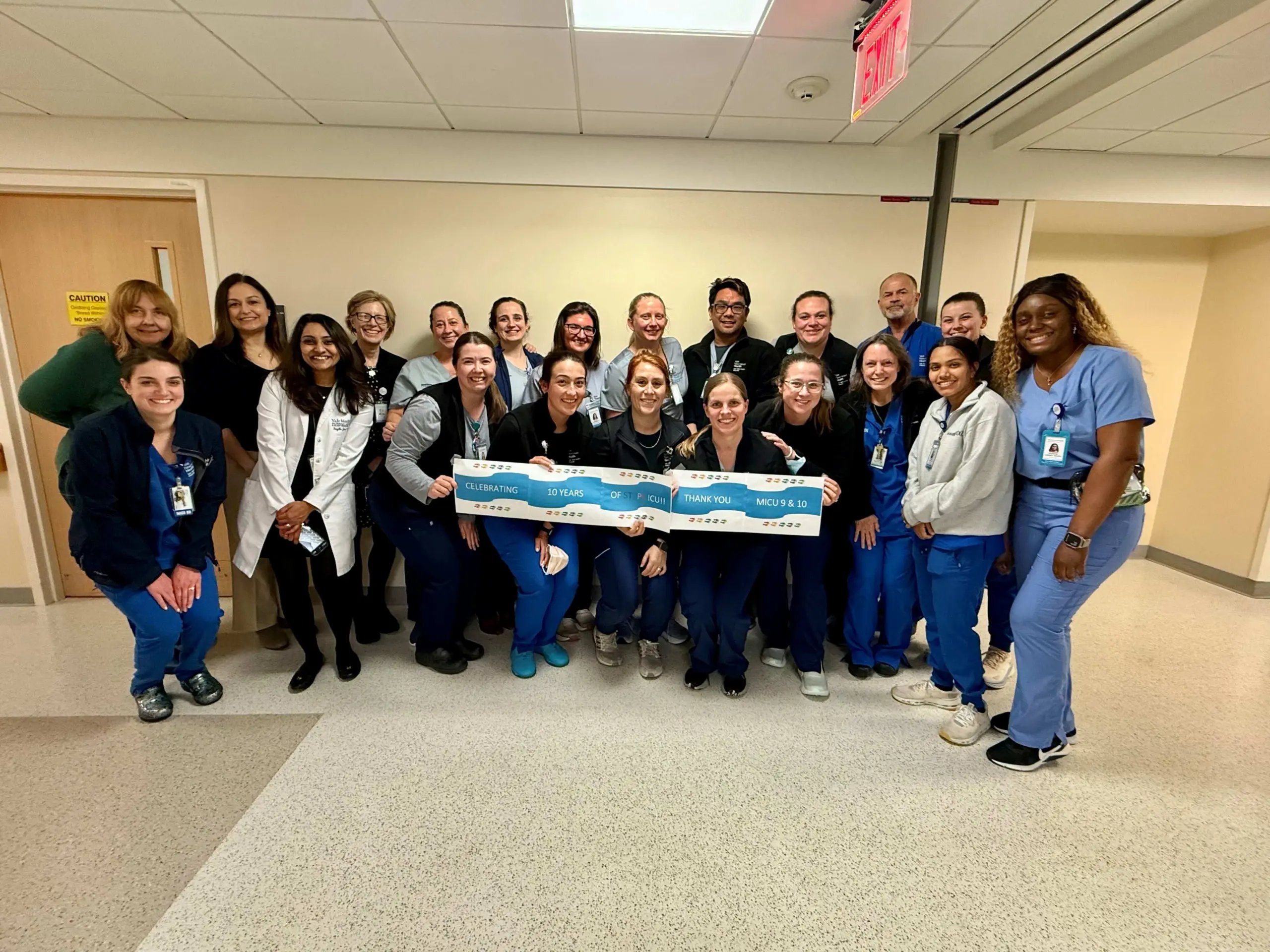
Jain (front row, second from left) and the ICU team in the Yale New Haven Hospital celebrate 10 years of the ICU Mobility Program that aims to mobilize patients in the ICU. Mobilizing ICU patients is part of Jain’s rehabilitation research program. Photo courtesy Snigdha Jain
The ICU is an environment that generates tremendous amounts of data: ventilator settings, vitals, labs, medications, imaging, consult notes, and minute-by-minute trends. That data richness is both an opportunity and a burden.
Clinicians are expected to synthesize it all, make high-stakes decisions quickly, and coordinate across large teams. In that setting, Jain is interested in decision support that reduces cognitive load and prompts the right reassessment at the right time.
Her goal is not to replace clinical reasoning. It is to strengthen it.
For Jain, tools are valuable when they help clinicians ask more meaningful questions. She believes that any data-driven intervention needs careful testing and re-testing, especially when it is introduced into a complex system like the ICU.
Her work starts with ventilator liberation: identifying patients who may be ready to come off the ventilator earlier, then supporting teams to act on that insight safely and consistently. In her view, shortening time on the ventilator is not only a metric. It is a path to better lives after critical illness, with fewer downstream complications and less long-term disability.
The longer arc is about health systems. Jain wants to build work that can scale, so that excellent reassessment is not dependent on one clinician’s vigilance. It becomes part of how the system behaves.
Why This Work Sustains Clinicians, Too
For Jain, the impact of diagnostic excellence is not limited to patients. It also affects clinicians, especially in critical care.
The ICU can be emotionally demanding. Even when teams do everything right, outcomes are not always good. That makes it easy for clinicians to feel they are running on urgency without closure.
Jain finds closure in a different setting: a post-ICU recovery clinic, where patients return after discharge. There, she can meet the people who once filled ICU beds and see what recovery really looks like. She can hear what families remember. She can understand what mattered most after the crisis passed.
“It’s a really nice win,” she said. “It gives you closure.”
That feedback loop, she believes, is part of what keeps clinicians grounded. It reminds teams that the details of ICU decision making are not only about surviving the week. They are about the years after.
The Scholars Program as a Multiplier
If Jain’s story has a through line, it is the insistence that diagnosis is not a single moment. It is a continuous practice that requires humility, clarity, and systems support.
That is what she brought with her.
What the Scholars in Diagnostic Excellence program has added is the multiplier effect: a platform that elevates the work, a shared language that makes uncertainty discussable, and a network that makes ideas sharper and more actionable.
For clinicians and researchers considering the program, Jain’s experience offers a clear message. You do not need to arrive with all the answers. But you should arrive with a real question, a problem you cannot stop thinking about, and a desire to build something that lasts beyond your own practice.
In the ICU, as she likes to remind trainees, it is OK not to know. What matters is what you do next.
Applications for the Scholars in Diagnostic Excellence program are open through March 2, 2026. Learn more and apply.
The NAM administers the program in partnership with the Council of Medical Specialty Societies, with generous support from the Gordon and Betty Moore Foundation. Jain is supported with additional funds from The John A. Hartford Foundation.